The Quran is the sacred word of Allah, revealed to Prophet Muhammad ﷺ over 23 years. Its verses carry layers of meaning — linguistic, historical, legal, and spiritual — that cannot be fully grasped from a surface-level reading alone. Indeed, this is precisely where Tafsir comes in. Known as the science of Quranic exegesis, Tafsir is the scholarly discipline of interpreting and explaining the meanings of Quranic verses. Whether you are a beginner who wants to read Quran online or an advanced student pursuing deep Islamic knowledge, understanding Tafsir is a transformative step in your journey.
Throughout Islamic history, scholars devoted entire lifetimes to perfecting this science. Yet the beauty of Tafsir is that it remains accessible to every Muslim — not only to the specialists. Here, we take a deep dive into what Tafsir is, why it matters, its major types, its rich history, and how you can begin studying it from the comfort of your home through online Quran lessons.
What is Tafsir? The Definition
The word “Tafsir” (تفسير) is derived from the Arabic root f-s-r (ف-س-ر), meaning “to explain,” “to expound,” or “to clarify.” Scholars use the term in Islamic scholarship to refer to the comprehensive explanation and interpretation of the Quran — covering its vocabulary, grammar, historical context (Asbab al-Nuzul), jurisprudential rulings, and spiritual dimensions.
Put simply, Tafsir is the bridge between the words of the Quran and the understanding of those words. Four essential questions lie at its heart:
• What does this verse mean?
• In what context was it revealed?
• How does it apply to our lives today?
• What did the Prophet ﷺ and his Companions understand from it?
One who performs Tafsir is known as a Mufassir (مفسّر). Among the classical Mufassirun are legendary scholars such as Ibn Kathir, Al-Tabari, Al-Qurtubi, and Al-Zamakhshari — each of whom produced monumental works that Muslim scholars still study today.
Why is Tafsir Important?
Understanding Tafsir is not just for scholars — it is for every Muslim who wants a deeper, more meaningful relationship with the Quran. Consider these five compelling reasons why Tafsir matters:
1. Unlocking the True Meaning
The Quran was revealed in classical Arabic — a language rich with nuance, metaphor, and multi-layered expression. Even a single Arabic word can carry dozens of connotations that no translation fully captures. As a result, Tafsir helps decode these meanings so that the reader truly grasps what Allah is communicating. Without it, even a careful reader might misinterpret a verse or miss its deeper spiritual message entirely.
2. Understanding Historical Context (Asbab al-Nuzul)
Many verses were revealed in response to specific events during the life of the Prophet ﷺ. Occasions of Revelation — called Asbab al-Nuzul — document exactly those circumstances. Knowing this background is critical for applying a verse correctly. For example, verses revealed during times of war or persecution carry very different implications when understood in their historical setting — implications that only become clear through Tafsir.
3. Guiding Islamic Practice and Law
A great many Islamic rulings — related to prayer, fasting, marriage, trade, and moral conduct — are derived directly from Quranic verses. Scholarly interpretation through Tafsir provides the framework that Islamic jurists use to derive these rulings (fiqh). Misunderstanding Quranic verses without proper Tafsir can therefore lead to significant errors in practice, which is why every serious student of Islam must engage with this discipline.
4. Spiritual Depth and Personal Growth
Far from being merely an intellectual exercise, Tafsir is, above all, a deeply spiritual one. When you read a verse and then explore its Tafsir, you discover layers of meaning that touch the heart, strengthen faith (iman), and inspire action. Many Muslims in fact report that studying Tafsir transforms their Salah (prayer), making every recitation far more meaningful and emotionally resonant.
5. Protection Against Misinterpretation
In today’s world, Quranic verses are frequently misquoted, taken out of context, or misused — by both critics of Islam and those who distort its message for political ends. Fortunately, a solid grounding in Tafsir equips Muslims to identify such misinterpretations and respond with knowledge and confidence. Given the era of widespread misinformation we live in, this protective role of Tafsir is more valuable than ever.
Major Types of Tafsir
Islamic scholarship recognizes several major approaches to Tafsir, each with its own methodology and emphasis. Understanding these distinctions helps students choose the right resource for their needs:
1. Bil-Ma’thur: Tafsir by Narration
Regarded as the most classical and authoritative approach, Bil-Ma’thur explains the Quran using:
• The Quran itself (Quran interpreting Quran)
• Hadith of the Prophet ﷺ
• Sayings of the Sahabah (Companions)
• Sayings of the Tabi’in (Successors)
The most famous example is Tafsir Ibn Kathir by Imam Ibn Kathir (d. 1373 CE), which remains one of the most widely read and trusted Tafsir works in the world today.
2. Bil-Ra’y: Tafsir by Reason
Rather than relying solely on transmitted reports, this approach employs rational analysis, linguistic study, and scholarly reasoning to interpret Quranic verses. Carried out correctly by qualified scholars with deep knowledge of Arabic, Hadith, and Islamic sciences, it is considered acceptable. However, Bil-Ra’y without proper scholarly grounding is considered dangerous and blameworthy (Tafsir bil-Ra’y al-Madhmum).
3. Al-Ishari: Sufi and Mystical Tafsir
Unlike the outward-focused approaches, Al-Ishari delves into the inner, spiritual meanings of Quranic verses — going beyond the outward (zahir) to explore the inward (batin). Rooted in Sufi traditions, it draws on scholars such as Ibn Arabi and Al-Tustari. While enriching for spiritual reflection, scholars emphasize that it should always be understood alongside — not in replacement of — the more established Tafsir traditions.
4. Al-Fiqhi: Jurisprudential Tafsir
As the name suggests, this approach focuses specifically on extracting legal rulings from the Quran. Landmark works like Ahkam al-Quran by Al-Jassas (Hanafi school) and Al-Jami’ li-Ahkam al-Quran by Al-Qurtubi are prime examples, serving as indispensable references for Islamic jurists.
5. Al-Ilmi: Scientific Tafsir
Among the more modern approaches, Al-Ilmi attempts to find references to scientific discoveries within the Quran. Although scholars continue to debate its validity, it has gained considerable popularity in contemporary Islamic discourse. Approached with care and modesty — without forcing meaning onto the text — it can deepen one’s appreciation for the Quran’s timeless wisdom.
A Brief History of Tafsir
The science of Tafsir did not emerge in a vacuum. Rather, it has a rich and layered history stretching back to the time of the Prophet ﷺ himself:
Prophetic Era: The Foundation
The first and greatest Mufassir was Prophet Muhammad ﷺ himself. Any time the Companions (Sahabah) were uncertain about the meaning of a verse, they would turn to him directly for clarification. Those explanations, subsequently preserved in the Hadith collections, form the bedrock of all classical Tafsir literature.
Companions (Sahabah): Guardians of Interpretation
After the Prophet ﷺ passed away, prominent Companions stepped forward as the leading interpreters of the Quran. Ibn Abbas (رضي الله عنه) — widely known as “The Interpreter of the Quran” — was among the most celebrated. Over time, he established foundational principles of Tafsir that scholars would build upon for centuries to come.
Era of the Tabi’in: Expanding the Tradition
Building upon the Companions’ legacy, the students of the Sahabah continued the tradition with great dedication. Consequently, major Tafsir schools emerged in key cities — Makkah, Madinah, and Iraq — each with its own scholars and methodological emphases.
Classical Period: 8th–15th Century CE
During this era, scholars compiled the great written Tafsir works that still define the field today. Above all, Al-Tabari’s monumental Jami’ al-Bayan (completed around 923 CE) is widely regarded as the most comprehensive classical Tafsir ever written, spanning over 30 volumes. Ibn Kathir, Al-Zamakhshari, Al-Qurtubi, and Al-Baydawi each produced their own landmark works, building on Al-Tabari’s towering achievement.
Modern Period: Tafsir for Contemporary Readers
Over the 19th and 20th centuries, scholars like Syed Qutb (Fi Zilal al-Quran), Mawdudi (Tafhim al-Quran), and Muhammad Abduh (Tafsir al-Manar) produced influential works that addressed contemporary issues in accessible language. Consequently, Tafsir became more widely available to general readers. To this day, Tafsir scholarship continues to evolve and expand globally.
Key Tafsir Works Every Muslim Should Know
• Tafsir Ibn Kathir — The most widely referenced classical Tafsir in English translation
• Tafsir al-Tabari (Jami’ al-Bayan) — The most comprehensive classical Tafsir in Arabic
• Tafsir al-Qurtubi — Rich in jurisprudential rulings and Islamic law
• Fi Zilal al-Quran (In the Shade of the Quran) by Syed Qutb — A moving 20th-century Tafsir
• Tafhim al-Quran by Abul Ala Mawdudi — A highly readable modern Tafsir with social and political insights
• Ma’ariful Quran by Mufti Muhammad Shafi — Widely used in English-speaking Muslim communities
How to Begin Studying Tafsir
Embarking on the study of Tafsir may feel overwhelming at first — but with the right approach and qualified teachers, it is deeply rewarding. Here is a practical step-by-step roadmap to get started:
1. Build Your Foundation: Read the Quran Correctly
Before studying Tafsir, a solid foundation in Quranic reading is essential. Being able to read Quran online fluently and accurately is the very first requirement. Complete beginners will find that starting with Noorani Qaida — the foundational primer for Quran recitation — provides the ideal entry point.
2. Master the Rules of Tajweed
Once you can read Arabic letters, the next priority is learning Tajweed — the rules of Quranic recitation. Mastering Tajweed ensures you recite the Quran exactly as it was revealed, which is both an obligation and a mark of deep respect for the divine text. Joining a Tajweed course online will equip you with this foundational skill under qualified guidance.
3. Explore Quranic Translation and Meaning
After establishing your recitation skills, the logical next step is to understand the meaning of what you recite. Enrolling in a Quran translation course will introduce you to the verse-by-verse meanings of the Quran and prepare you well for deeper Tafsir study.
4. Choose an Accessible Tafsir Work
For English speakers, beginning with Ma’ariful Quran by Mufti Muhammad Shafi or an abridged edition of Tafsir Ibn Kathir is highly recommended. Rather than trying to read everything at once, integrate a few pages of Tafsir into your daily Quran recitation to build the habit gradually and sustainably.
5. Learn Under Qualified Scholars
Without doubt, the most effective way to study Tafsir is under the guidance of qualified Islamic scholars. Nowadays, online platforms make this more accessible than ever through online Quran classes offered by trusted institutions. Skilled online Quran teachers will not only explain verses in depth but also help you avoid common pitfalls in interpretation.
Study Tafsir and Quran Online with Quran Institute Online Canada
At Quran Institute Online Canada, we understand that every student’s journey is unique. From complete beginners who want to read Quran online for the first time to advanced students deepening their understanding through Tafsir, our qualified online Quran teachers are here to guide you every step of the way.
To support students at every level, we offer a comprehensive range of courses:
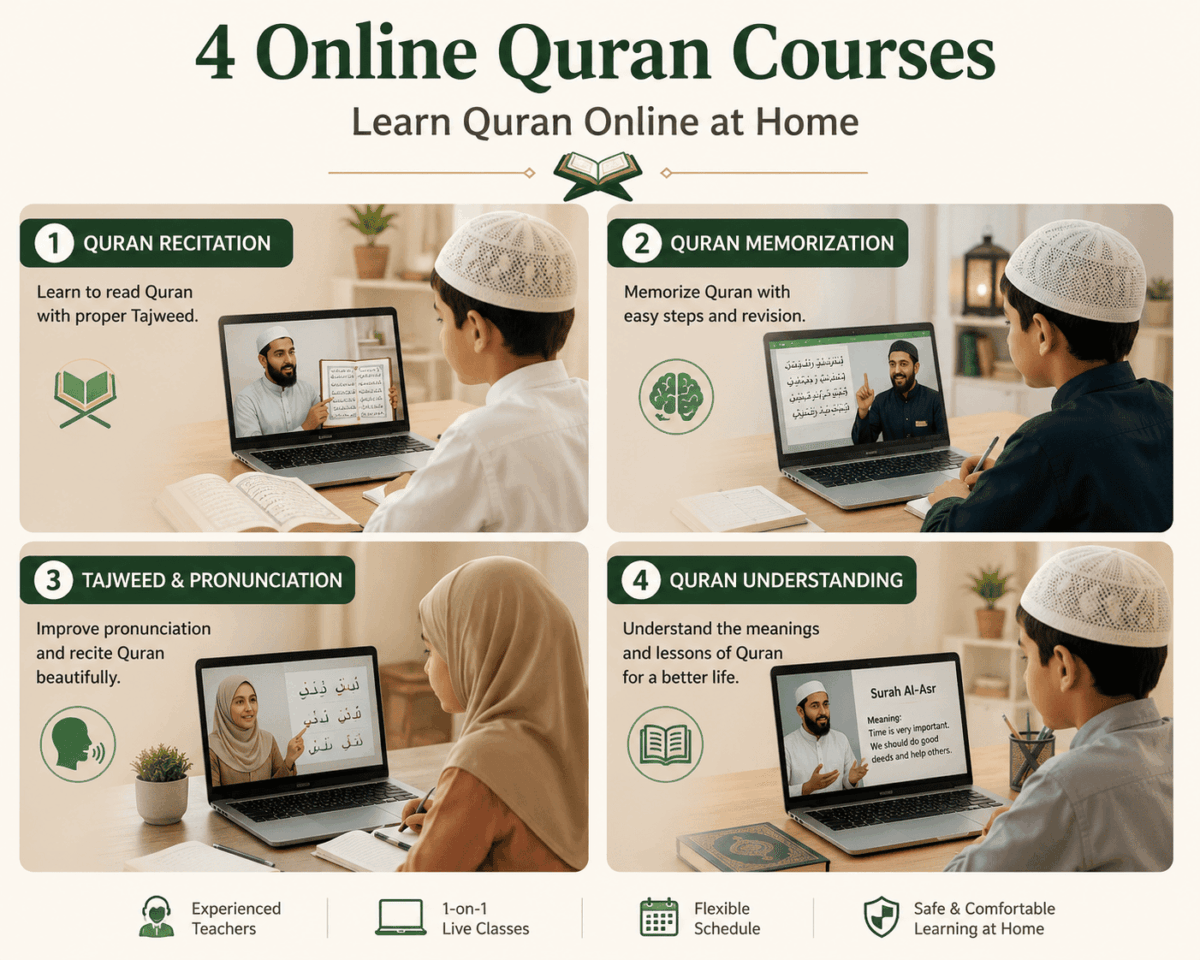
• Quran Reading Course — Learn to read the Quran accurately, from beginner to advanced level
• Noorani Qaida Course — The ideal starting point for children and adult beginners alike
• Quran Memorization Course — Memorize Quran online with personalized support from expert Huffaz
• Quran Translation Course — Understand the meaning of every verse you recite
• Tajweed Guidelines — Master the art of beautiful, correct Quranic recitation
Proudly serving as a leading online Quran Institute in Canada, we provide flexible scheduling, one-on-one online Quran lessons, and a warm, supportive learning environment for students of all ages — across Canada and around the globe.
The Connection Between Tafsir and Memorizing the Quran
Many students who aim to memorize Quran online discover that studying Tafsir dramatically enhances their memorization. Students who truly understand the meaning and context of the verses they are committing to memory find those verses far easier to retain. Moreover, the emotional and intellectual engagement that Tafsir study brings creates a deeper bond with the text — transforming memorization from a mechanical exercise into a genuinely spiritual experience.
For this reason, pairing your Quran memorization course with foundational Tafsir study is highly recommended for anyone on the path to becoming a Hafiz or Hafiza. Expert teachers at our online Quran Academy can help you integrate both aspects of learning seamlessly and effectively.
Conclusion: Tafsir — The Key to Understanding Allah’s Words
Tafsir is far more than an academic discipline — it is the key to unlocking the living guidance of the Quran. By way of Tafsir, the words of Allah move from the page to the heart, from language to law, and from ancient history into our daily lives.
No matter where you live — whether in Canada, across North America, or anywhere in the world — the doors of Quranic knowledge are wide open to you today. Having qualified online Quran teachers, structured online Quran classes, and the convenience of learning from home means there has truly never been a better time to begin or deepen your journey with the Quran.
Begin your journey today with Quran Institute Online Canada — where authentic Islamic knowledge meets modern, accessible learning. Join our online Quran Academy and embark on the transformative path of truly understanding the Book of Allah. Ready to Begin? Enroll in Online Quran Classes Today