

Categories
Uncategorized

How To Effectively Learn The Quran Online

Learning the Quran is one of the most rewarding journeys a Muslim can undertake, whether you’re just starting to read Arabic or working toward memorizing the entire Book. Thanks to technology, it’s now easier than ever to learn Quran online from the comfort of your home — no matter where you live in Canada or beyond. But with so many platforms and courses available, how do you make sure your online learning experience is actually effective?

In this guide, we’ll walk you through practical, proven strategies to get the most out of online Quran classes, so you can build a strong, lasting connection with the Quran.

1. Choose the Right Online Quran Academy

Your learning outcomes depend heavily on the platform and teachers you choose. A reputable online Quran Academy should offer:

  • Qualified, experienced instructors
  • Flexible scheduling for students across different time zones
  • Structured courses for every level, from beginners to advanced students
  • One-on-one or small group sessions for personalized attention

Look for an Online Quran Institute in Canada that understands the needs of Canadian students — whether that means evening classes around school and work schedules, or instructors who can teach comfortably in English.

2. Start With the Basics: Noorani Qaida

If you or your child are new to reading Arabic, don’t skip the fundamentals. Learning Noorani Qaida is the essential first step before moving on to Quran reading. It teaches:

  • Arabic letter recognition and pronunciation
  • Basic Tajweed rules
  • Joining letters to form words
  • Reading short verses with correct articulation

Rushing past this stage often leads to poor pronunciation habits later on. A solid foundation in Noorani Qaida makes every step afterward — reading, memorization, and Tajweed — far smoother.

3. Focus on Correct Tajweed From Day One

Tajweed refers to the rules governing how the Quran should be recited — correct pronunciation, articulation points, and the proper rhythm of recitation. Learning Tajweed isn’t optional if you want to recite the Quran the way it was revealed.

Effective online learning means practicing Tajweed rules consistently, not just memorizing them in theory. A good teacher will:

  • Correct your pronunciation in real time during live sessions
  • Explain the “why” behind each rule, not just the rule itself
  • Give you regular listening and repetition exercises

4. Set Clear Goals: Reading vs. Memorization

Before you begin, decide what you want to achieve. Are you looking to:

Each goal requires a different approach and pace. A structured Quran reading course builds fluency and confidence, while a memorization program focuses on repetition, revision schedules, and retention techniques. Knowing your goal upfront helps your teacher tailor your online Quran lessons accordingly.

5. Be Consistent — Little and Often Beats Long and Rare

One of the biggest advantages of online learning is flexibility, but that flexibility only pays off if you stay consistent. A short 20–30 minute session four or five times a week will almost always produce better results than one long session per week.

Tips for staying consistent:

  • Set a fixed time each day for your Quran lesson, just like any other appointment
  • Use reminders or calendar alerts
  • Track your progress weekly to stay motivated
  • Involve family members if your children are learning too — accountability helps

6. Choose Qualified Online Quran Teachers

The quality of your online Quran teachers makes a significant difference in how quickly and correctly you learn. Look for teachers who:

  • Are certified in Tajweed and Quran recitation (ideally with an Ijazah)
  • Have experience teaching students of your age group and level
  • Communicate clearly and patiently, especially with beginners and children
  • Provide regular feedback and progress updates

Don’t hesitate to request a trial class before committing to a course. This gives you a feel for the teacher’s style and confirms it’s a good fit for you or your child.

7. Use the Right Tools and Environment

Effective online learning isn’t just about the teacher — your setup matters too:

  • Use a stable internet connection and a quiet, distraction-free space
  • Keep a physical or digital Mushaf (Quran copy) on hand during lessons
  • Use headphones for clearer audio, especially when practicing Tajweed
  • Review recorded sessions (if available) to reinforce what you learned

8. Reinforce Learning Outside of Class

What you do between lessons matters just as much as the lesson itself. To retain what you’ve learned:

  • Practice recitation daily, even briefly
  • Listen to Quran recitation from qualified reciters to train your ear
  • Revise previously memorized portions regularly to prevent forgetting
  • Ask your teacher questions about anything unclear, rather than letting confusion build up

Final Thoughts

Learning the Quran online is not only convenient — when approached the right way, it can be just as effective, if not more so, than in-person learning. The key is choosing a trustworthy academy, starting with strong fundamentals like Noorani Qaida, prioritizing correct Tajweed, and staying consistent with your practice.

If you’re ready to begin, explore our Quran reading, Quran memorization, Noorani Qaida, and Quran translation courses at Quran Institute Online Canada, and take the first step toward a lifelong connection with the Quran — guided by experienced, qualified teachers, wherever you are in Canada. Contact us here and let’s get started

Categories
Uncategorized

Why Muslims Pray 5 Times a Day?

Prayer, or Salah, is one of the most visible and consistent acts of worship in Islam. Five times a day, no matter where they are in the world, Muslims pause their daily routines to stand before Allah in prayer. For someone unfamiliar with Islam, this might raise a simple but important question: why five times, and why every single day?

At Quran Institute Online Canada, we believe understanding the “why” behind Salah makes the practice more meaningful — especially for students who are just beginning their journey to learn Quran online or deepen their connection with their faith. In this post, we’ll explore the spiritual, practical, and historical reasons behind the five daily prayers.

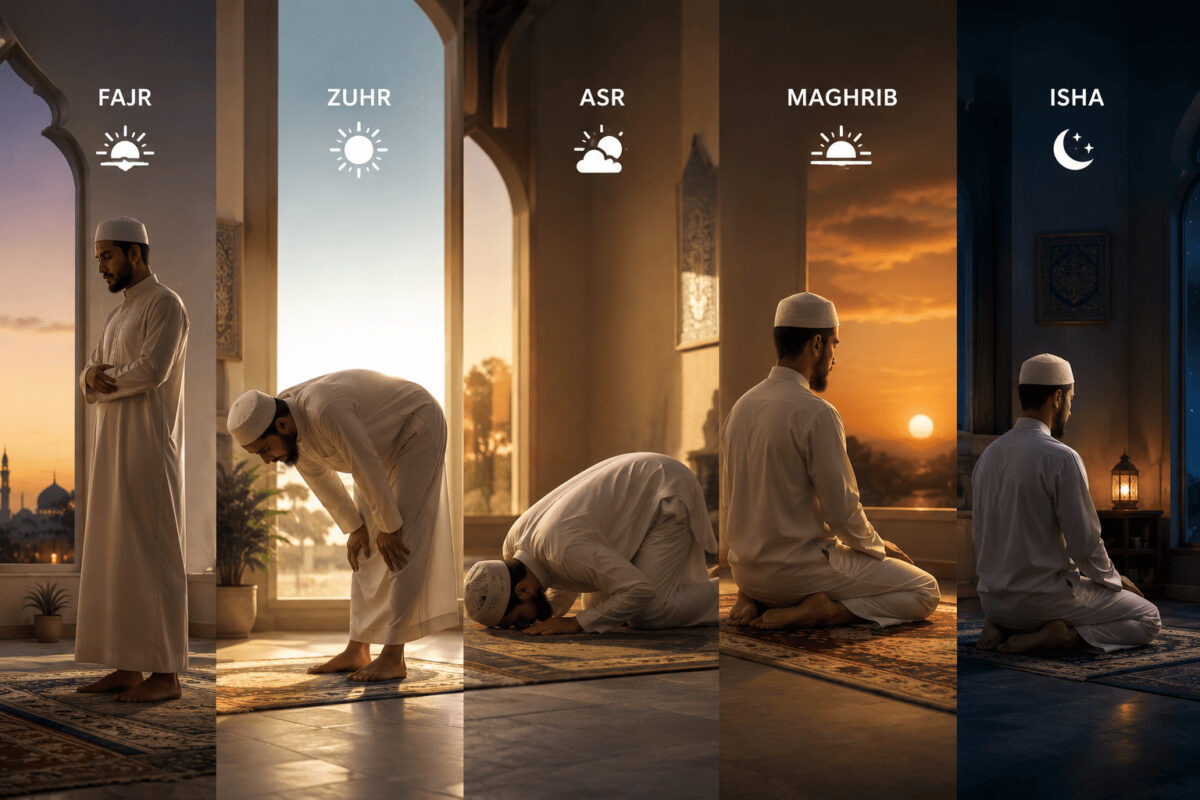
The Five Daily Prayers

Before diving into the reasons, it helps to know what the five prayers actually are:

  1. Fajr – The dawn prayer, performed before sunrise
  2. Dhuhr – The midday prayer, performed after the sun passes its peak
  3. Asr – The afternoon prayer
  4. Maghrib – The sunset prayer, performed just after the sun sets
  5. Isha – The night prayer

Each prayer is tied to a specific time of day, creating a rhythm that structures a Muslim’s entire schedule around remembrance of God.

1. Salah Is a Direct Command from Allah

The most fundamental reason Muslims pray five times a day is that it was commanded by Allah. According to Islamic tradition, the obligation of five daily prayers was established during the Night Journey (Isra and Mi’raj), when Prophet Muhammad (peace be upon him) ascended through the heavens and received this instruction directly.

Salah is one of the Five Pillars of Islam, alongside the declaration of faith (Shahada), fasting (Sawm), charity (Zakat), and pilgrimage (Hajj). Because it is a pillar — not an optional practice — it holds a central place in a Muslim’s daily life.

2. Prayer Keeps a Muslim Connected to God Throughout the Day

Life is busy. Work, family, studies, and countless distractions can easily pull a person’s attention away from their faith. Praying five times a day acts as a built-in reminder, pulling a Muslim back to a state of mindfulness and gratitude at regular intervals.

Rather than reserving worship for a single day of the week, Islam integrates it into the rhythm of everyday life — morning, midday, afternoon, evening, and night. This constant connection is part of why many students who begin Online Quran Classes find that their understanding of prayer becomes deeper once they can actually recite and understand what they’re reading in Salah.

3. It Builds Discipline and Structure

Five daily prayers naturally create structure. Waking up for Fajr before sunrise instills discipline; pausing for Dhuhr and Asr during a busy workday teaches balance; and Maghrib and Isha bring closure and reflection to the day.

Over time, this structure shapes character — punctuality, self-control, and consistency become habits that extend beyond prayer itself into other areas of life.

4. Purification of the Heart and Mind

Prophet Muhammad (peace be upon him) compared the five daily prayers to a river flowing outside someone’s door, in which they bathe five times a day. Just as physical dirt would not remain on a person who bathes that often, sins and spiritual negligence are cleansed through consistent prayer.

Each Salah offers a fresh opportunity to seek forgiveness, reset one’s intentions, and refocus on what truly matters.

5. A Reminder of Equality and Community

While much of Salah can be performed individually, it also has a powerful communal dimension. Muslims around the world — regardless of nationality, language, or background — face the same direction (the Qibla) and perform the same movements at their respective prayer times. This shared practice reinforces a sense of unity and equality within the global Muslim community, the Ummah.

How Learning to Pray Properly Starts with the Quran

Understanding why Muslims pray is only part of the picture. Praying correctly requires knowledge — of Arabic pronunciation, the meaning of the verses recited, and the etiquette of worship. This is where structured learning becomes essential.

  • Beginners often start with Learn Noorani Qaida, which teaches the foundational rules of Arabic letters and pronunciation needed to recite prayers correctly.
  • Students then move on to Read Quran online courses to build fluency in reciting the Quran itself.
  • Many students go further and choose to Memorize Quran online, allowing them to recite longer portions of the Quran during their prayers, particularly during Tarawih or voluntary night prayers.
  • Correct recitation also depends heavily on Tajweed, the set of rules governing how Quranic Arabic should be pronounced. You can learn more about its importance in our article on the significance of Tajweed guidelines.

Why Learn With an Online Quran Academy?

For Muslims living in Canada — especially converts, busy professionals, or parents raising children in a non-Arabic-speaking environment — access to qualified instruction can be limited locally. This is why so many families turn to an Online Quran Academy for guided, structured learning from home.

At our Online Quran Institute in Canada, we offer:

  • One-on-one Online Quran lessons tailored to each student’s level
  • Certified Online Quran teachers experienced in teaching children and adults
  • Flexible scheduling that fits around work, school, and family life
  • A supportive, patient learning environment rooted in correct Tajweed and understanding

Final Thoughts

The five daily prayers are far more than a religious obligation — they are a source of discipline, spiritual purification, and constant connection with Allah throughout the day. But to truly benefit from Salah, understanding the Quran and learning to recite it correctly is essential.

If you’re ready to strengthen your prayers and deepen your relationship with the Quran, our instructors are here to guide you every step of the way.

Ready to begin? Book your free trial class today and start your journey to learn Quran online with expert guidance.

Categories
Uncategorized

How to Pray Fajr for Beginners: A Comprehensive Step-by-Step Guide

Fajr, the dawn prayer, is one of the most beautiful and spiritually rewarding acts of worship in Islam. It marks the beginning of a Muslim’s day with remembrance of Allah, and the Prophet Muhammad (peace be upon him) placed special emphasis on its importance. For beginners, however, praying Fajr can feel intimidating — waking up before sunrise, remembering the correct steps, and reciting with confidence. This guide breaks the process down step by step so you can build a consistent, meaningful Fajr routine.

Whether you’re new to Islam, returning to your faith, or simply want a refresher, this article will walk you through everything you need to know, from preparation to the prayer itself.

Why Fajr Matters

Fajr holds a unique status among the five daily prayers. It is prayed at dawn, before sunrise, when the world is quiet and most people are still asleep. The Quran itself references the significance of this time, and the Prophet ﷺ described the reward of praying Fajr in congregation as equivalent to praying the entire night.

For beginners, understanding why Fajr matters can be just as important as knowing how to pray it — it provides the motivation to wake up and start the habit.

Step 1: Prepare the Night Before

Success with Fajr often starts the night before:

  • Set an alarm with enough buffer time to wake up, perform ablution (wudu), and pray calmly.
  • Sleep early and avoid heavy meals or screens right before bed.
  • Make the intention (niyyah) to wake up for Fajr — this small mental commitment matters spiritually and practically.

Step 2: Perform Wudu (Ablution)

Before any prayer, you must be in a state of ritual purity. Wudu involves:

  1. Making the intention to purify yourself for prayer.
  2. Washing your hands three times.
  3. Rinsing your mouth and nose three times.
  4. Washing your face three times.
  5. Washing your arms up to the elbows three times, starting with the right.
  6. Wiping your head once with wet hands.
  7. Wiping your ears once.
  8. Washing your feet up to the ankles three times, starting with the right.

If you’re new to these steps, taking a structured course can help — many beginners find it useful to Learn Quran online alongside learning the practical fundamentals of prayer, since the two go hand in hand.

Step 3: Know the Structure of Fajr Prayer

Fajr consists of two Sunnah rak’ahs followed by two Fard (obligatory) rak’ahs. Understanding this structure removes a lot of the confusion beginners face:

  • 2 Sunnah rak’ahs — highly recommended, prayed individually before the Fard prayer.
  • 2 Fard rak’ahs — the obligatory portion, which can be prayed individually or in congregation.

Step 4: The Step-by-Step Prayer

Here is a simplified walkthrough of each rak’ah:

  1. Stand facing the Qiblah (direction of the Kaaba) and make your intention (niyyah) silently in your heart.
  2. Say “Allahu Akbar” (Takbeer) while raising your hands to begin the prayer.
  3. Recite Surah Al-Fatiha, followed by another short surah or a few verses from the Quran.
  4. Bow (Ruku) while saying “Allahu Akbar,” placing your hands on your knees and keeping your back straight.
  5. Rise from Ruku, saying “Sami Allahu liman hamidah” followed by “Rabbana lakal hamd.”
  6. Prostrate (Sujood) saying “Allahu Akbar,” placing your forehead, nose, palms, knees, and toes on the ground.
  7. Sit briefly, then prostrate a second time.
  8. Stand up for the second rak’ah and repeat the recitation and movements.
  9. After the second rak’ah’s second prostration, sit for Tashahhud, recite the required supplications, and end the prayer with Taslim (turning your head to the right and left, saying “Assalamu alaikum wa rahmatullah”).

For the Fard prayer, the same structure is followed, though the recitation after Al-Fatiha is typically shorter (especially in congregational settings, where the Imam leads).

Step 5: Recitation — Building Confidence with the Quran

One of the biggest hurdles for beginners is Arabic recitation. If you’re not yet comfortable reciting Surah Al-Fatiha or short surahs, structured learning can make a real difference:

  • Beginners often start with Learn Noorani Qaida, which teaches the foundational Arabic letters and pronunciation needed for prayer.
  • Once comfortable with the basics, many move on to Read Quran online to build fluency with longer passages.
  • For those who want to go further and commit verses to memory for prayer, you can Memorize Quran online with guided support.

Correct pronunciation isn’t just about sounding right — it directly affects the meaning of what you’re reciting. This is where Tajweed becomes essential. Tajweed refers to the rules governing how Quranic Arabic should be pronounced, and learning even the basics can transform how confidently you pray. You can read more about the significance of Tajweed guidelines and how they apply to daily prayer.

Step 6: Common Mistakes Beginners Make

  • Rushing through movements — each position (standing, bowing, prostrating) should be performed calmly and completely.
  • Mispronouncing Quranic verses — this is why guided learning matters, especially in the early stages.
  • Praying without understanding — even a basic grasp of what you’re reciting adds depth to the prayer.
  • Skipping Fajr due to difficulty waking up — building the habit gradually, rather than expecting perfection immediately, leads to long-term consistency.

Step 7: Building a Sustainable Fajr Habit

Consistency matters more than perfection. Some practical tips:

  • Place your alarm across the room so you have to physically get up.
  • Drink a glass of water immediately after waking to help alertness.
  • Pray with a family member or join a local congregation when possible for accountability.
  • Track your progress — small wins build momentum.

Learning Beyond the Basics

Fajr is often the entry point for a much deeper journey into Islamic learning. Many beginners who start by simply learning how to pray go on to explore the Quran more broadly — its meaning, recitation, and memorization.

If you’re looking for structured, one-on-one guidance, an Online Quran Academy can provide a clear learning path tailored to your level, whether you’re a complete beginner or looking to refine your Tajweed.

For families and individuals across Canada seeking Online Quran lessons from qualified instructors, working with a trusted Online Quran Institute in Canada can make the learning process far more structured than trying to piece it together alone.

Our experienced Online Quran teachers work with students of all ages and skill levels, offering flexible scheduling to fit around work, school, and family commitments — including early morning sessions for those building their Fajr routine.

Final Thoughts

Learning to pray Fajr as a beginner is a journey, not a single event. It combines physical preparation (wudu, waking up on time), spiritual intention, and gradually building confidence in Quranic recitation. With consistent practice — and the right guidance — Fajr can become one of the most peaceful and grounding parts of your day.

If you’d like structured support in learning to recite, understand Tajweed, or memorize the Quran to enrich your prayers, our instructors are here to help you build a strong, lasting foundation. Contact us here and let’s get started