
Categories
Uncategorized

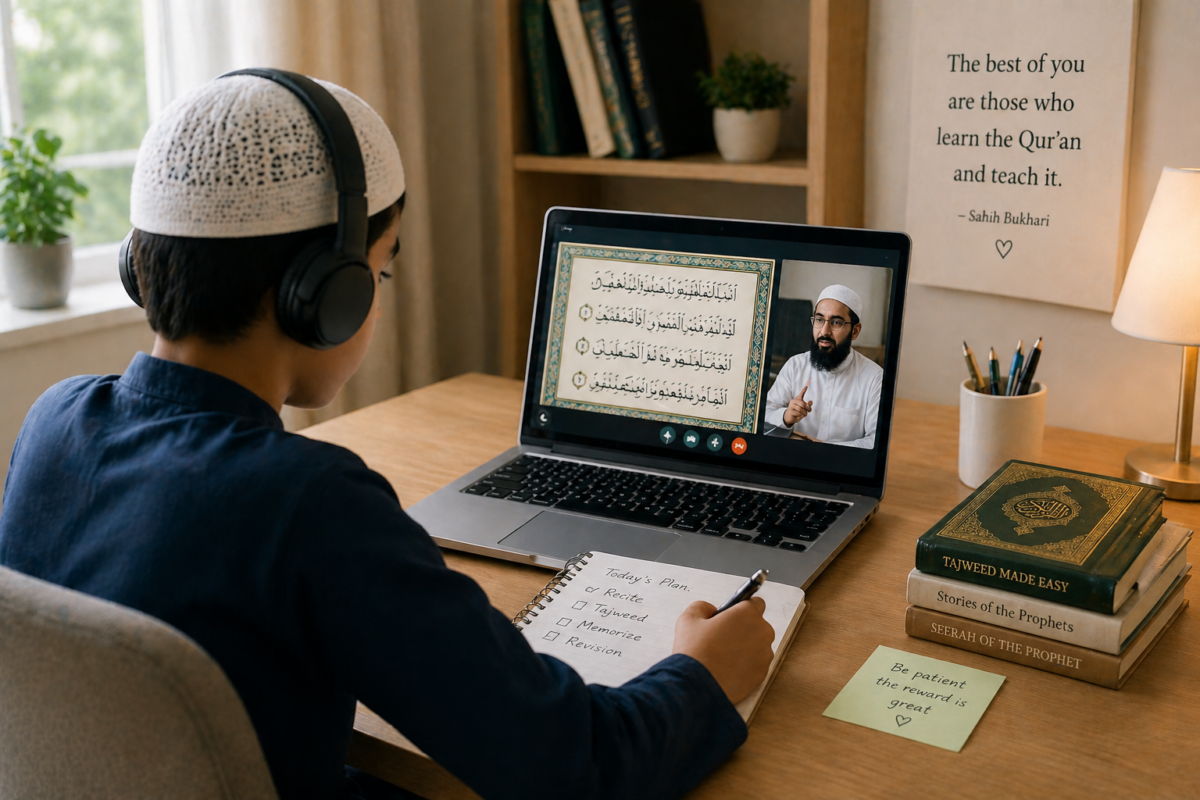
Quran Memorization Online Course: Do They Actually Work?

Memorizing the Quran, or completing Hifz, has traditionally meant sitting in front of a teacher at a local mosque or madrassah. Students repeat verses for hours until they’re locked into memory. So when online learning entered the picture, many parents and students asked a fair question: can you really memorize Quran online? Or is this just a watered-down version of the real thing?

It’s a reasonable concern. Quran memorization is sacred work. Nobody wants to cut corners on something this important. The good news is that, when done correctly, online Hifz programs are effective. They often outperform traditional setups in consistency, personalization, and accessibility. Let’s break down why.

The Skepticism Around Online Quran Memorization

Before diving into what works, it’s worth acknowledging where the doubt comes from. A few common concerns keep coming up.

“How can a teacher correct my child’s pronunciation through a screen?” This is probably the most frequent objection. Tajweed and proper pronunciation feel like they need in-person correction. Hand gestures and physical demonstration of mouth and tongue positioning seem essential.

“Won’t my child get distracted at home?” Home environments come with siblings, toys, snacks, and a hundred other things competing for attention. A structured classroom feels safer.

“Is there real accountability?” In a physical class, a teacher can see if a student is paying attention. Some worry that online classes let students coast without anyone noticing.

These are legitimate questions. The answer comes down to how the program is structured, not whether it happens online or offline.

How Online Quran Memorization Actually Works

A well-run online Quran academy doesn’t just throw a student in front of a webcam and hope for the best. Effective programs are built around a few core elements.

One-on-one or small-group sessions

In a crowded classroom, a teacher’s attention is split across 20-30 students. Online platforms typically offer one-on-one or very small group sessions instead. This means more correction time per student, not less. An online Quran teacher working with one student can catch a mispronounced letter right away. The student repeats it until it’s right. That’s hard to do consistently in a packed physical classroom.

Real-time audio and video correction

Modern video call quality is more than sufficient for this work. A teacher can hear and see mouth movement, tongue placement, and breathing patterns needed to correct Tajweed rules. Many Online Quran teachers actually find it easier to focus purely on listening when video reduces other classroom distractions.

Structured revision (Muraja’ah) systems

Memorization isn’t just about adding new verses. It’s about retaining old ones too. Reputable online programs build in dedicated revision time. They track which portions a student has memorized and schedule regular reviews so nothing is forgotten. This kind of systematic tracking is often more consistent online than in informal in-person setups, where revision can get pushed aside.

Recorded progress and parental visibility

Parents can sit in on sessions, review recordings, or receive progress reports. This level of transparency is something a drop-off mosque class rarely offers.

What the Research and Experience Actually Show

Educational research on online learning supports a simple conclusion: outcomes depend far more on instructional design and engagement than on the medium itself. The same logic applies to Quran memorization. A distracted teacher in a physical classroom with 30 kids produces worse outcomes than a focused, well-trained teacher working one-on-one online.

Anecdotally, many families who’ve tried both formats report that online sessions increase consistency. There’s no commute and no missed days due to weather or transportation issues. Scheduling is flexible enough to fit around school and work. For working parents trying to give their children an Islamic education, this flexibility often makes the difference between starting Hifz and never getting around to it.

What Makes an Online Program Effective (and What Doesn’t)

Not every program labeled “online Quran classes” is built the same. Here’s what separates effective platforms from mediocre ones.

Qualified, certified teachers. Look for instructors with verified ijazah (certification) in Quran recitation and a background in Tajweed. A platform’s credibility rests almost entirely on its teaching staff.

Small class sizes or one-on-one format. Group sizes should be small enough that every student gets individual correction within each session.

A clear curriculum path. Good programs don’t just “wing it.” They typically start students with Noorani Qaida to build foundational reading skills. Next comes a structured Quran reading course. Only then does memorization begin, with proper Tajweed woven in throughout.

Built-in Tajweed instruction. Memorization without correct pronunciation isn’t the goal. Strong programs integrate Tajweed rules from the start rather than treating it as a separate, optional add-on.

Regular assessment and revision. Ask how the program tracks what’s been memorized and how often it’s reviewed. If there’s no clear answer, that’s a red flag.

Trial classes. Reputable academies typically offer a free trial class. This lets families evaluate teaching style and platform quality before committing.

Building the Right Foundation First

One mistake families sometimes make is jumping straight into memorization. They skip mastering Arabic letter recognition and proper pronunciation first. This is where learning Noorani Qaida becomes essential. It’s the foundational step that teaches Arabic script, makhraj (articulation points), and basic Tajweed rules. Students learn this before ever attempting to memorize a full surah.

Skipping this step is a common reason memorization efforts stall. A student who hasn’t mastered correct pronunciation will memorize incorrect pronunciation right along with the words. Unlearning bad habits later is far harder than building good ones from the start.

Some students want to understand the meaning behind what they recite. Pairing memorization with a Quran translation course adds another layer of depth. It connects memorized verses to their actual meaning, not just their sound.

Tajweed: The Piece That’s Easy to Overlook

It’s worth pausing on Tajweed specifically. It’s often treated as secondary to memorization, when really the two should develop together. Tajweed isn’t just about sounding good when reciting. It governs the correct pronunciation of Arabic letters and how they interact, which directly affects meaning. Proper Tajweed application is considered essential to reciting the Quran correctly, not an optional enhancement.

A quality online program treats Tajweed as integrated, not separate. Teachers correct pronunciation in real time as a student memorizes, rather than saving it for a later “advanced” stage.

Is Online Quran Memorization Right for Your Family?

Online Hifz programs work well for families who value flexibility. They suit families who want more individualized teacher attention than a crowded local class can offer, and who can maintain a consistent home routine. They tend to work less well when there’s no structure at home at all. Even the best teacher can’t fully compensate for a chaotic learning environment on the student’s end. A consistent time, a quiet space, and parental encouragement go a long way toward making any program succeed, online or offline.

For adults who want to learn Quran online themselves, the same principles apply. Consistency, a structured curriculum, and a qualified teacher matter more than the platform itself.

Final Thoughts

So, do online Quran memorization courses actually work? The evidence points to yes, provided the program is structured well. This holds true both in educational research and in the experiences of families who’ve tried it. One-on-one attention, integrated Tajweed instruction, systematic revision, and qualified teachers are the real drivers of success. A well-run online program can deliver all of these, often more consistently than an overcrowded in-person class.

If you’re considering this path for yourself or your child, look for an Online Quran Institute in Canada with experienced Online Quran teachers. Find one with a clear curriculum starting from Noorani Qaida through to full memorization, and a trial class so you can judge the teaching quality before enrolling. Contact us for free trail classes.


Categories
Uncategorized

Some Important Tips to Memorize Quran

Memorizing the Quran is one of the greatest spiritual achievements a Muslim can pursue. Whether you are just beginning your journey to learn Quran online or you are already enrolled in structured online Quran classes, developing the right habits and mindset is essential. In this guide, we share some important and practical tips to help you memorize Quran online with consistency, confidence, and deep understanding.

1. Build a Strong Foundation: Start With Noorani Qaida

Before you can memorize, you must be able to read Quran online with proper pronunciation. Many students skip this step and struggle later. If you are a beginner, the best place to start is to learn Noorani Qaida — a foundational course that teaches you Arabic letters, vowels, and basic reading rules.

Noorani Qaida builds your reading fluency step by step, making the memorization journey much smoother. Without this base, you may mispronounce words and unknowingly memorize them incorrectly — something that is very difficult to unlearn later.

Why This Matters

  • Correct Arabic pronunciation from day one
  • Stronger letter recognition speeds up memorization
  • Builds confidence before moving to longer Surahs

2. Master Tajweed — Recite the Way the Quran Was Revealed

One of the most important tips for Quran memorization is learning the rules of Tajweed. Tajweed refers to the set of rules that govern correct Quran recitation — covering elongation, stopping points, and the qualities of each letter.

When you memorize with correct Tajweed, your recitation becomes more melodic and natural, which actually helps the memory retain the verses better. Errors in Tajweed can also change the meaning of words, so learning it properly is both a spiritual and practical necessity.

Quick Tajweed Tips

  • Listen to a qualified Qari reciting the verses you are memorizing
  • Record yourself and compare with correct recitation
  • Take dedicated Tajweed lessons through structured online Quran lessons

3. Set a Daily Memorization Schedule

Consistency is the single most important factor in Quran memorization. Even memorizing just 3 to 5 new verses per day, consistently, will help you complete the entire Quran in a few years. The key is not how much you memorize each day — it is that you show up every single day.

Choose a fixed time for your Hifz session. Early morning, after Fajr prayer, is widely recommended by scholars because the mind is fresh and free from distractions.

Suggested Daily Routine

  • After Fajr: Revise yesterday’s verses (5–10 minutes)
  • Morning session: Memorize new verses (15–20 minutes)
  • Evening: Recite the new verses in salah to reinforce memory

4. Use Repetition — The Core of Hifz

Repetition is the backbone of Quran memorization. Scholars of Hifz traditionally recommend repeating each new verse a minimum of 20 times before moving to the next. This repetition encodes the verse deep into long-term memory rather than just short-term recall.

A simple and effective method is to read a verse out loud 10 times while looking at the Quran, then close the Quran and repeat it from memory 10 more times. If you make a mistake, open the Quran, correct yourself, and repeat the process.

5. Revise, Revise, Revise

New memorization without revision is like pouring water into a leaking bucket. You must consistently revise previously memorized portions alongside learning new ones. Many Huffaz (those who have memorized the Quran) follow a rule: for every new page memorized, revise the previous five pages.

Over time, increase your revision load. A strong revision system is what separates those who complete Hifz from those who lose what they have memorized partway through.

Revision Strategy

  • Daily: Revise the last 1–2 pages learned
  • Weekly: Revise the full Juz (chapter) you are working on
  • Monthly: Revise all memorized Juz from the beginning

6. Learn Under Qualified Online Quran Teachers

One of the biggest advantages of enrolling in a structured program is access to experienced online Quran teachers. A qualified teacher will correct your mistakes immediately, keep you accountable, and guide your Tajweed. Without a teacher, small errors in pronunciation or memorization can go unnoticed for months.

Modern technology has made it easier than ever to connect with certified Quran teachers from the comfort of your home. With flexible scheduling and one-to-one sessions, online learning removes the barriers of distance and time.

7. Understand What You Memorize

Memorization is strengthened when you understand the meaning of what you are reciting. Consider enrolling in a Quran translation course alongside your Hifz program. When you understand the message of each verse, the words become more meaningful and memorable.

You do not need to become a scholar, but even a basic understanding of the Arabic meaning helps you connect emotionally with the verses — and emotional connection dramatically improves memory retention.

8. Recite in Your Prayers

One of the best and most natural ways to revise your memorized portions is to recite them during your daily prayers. Every Salah is an opportunity to strengthen your Hifz. Start with shorter Surahs in Fajr and Isha, and gradually incorporate newly memorized verses as they become solid.

This practice means you are revising your memorization at least five times a day in a deeply spiritual and focused state — making it one of the most effective revision methods available.

9. Create a Distraction-Free Environment

Quran memorization requires deep focus. Choose a quiet, clean space dedicated to your Hifz sessions. Put your phone on silent, inform family members of your schedule, and approach your session with the same seriousness you would give to an important exam.

Some students find that reciting out loud in a slightly raised voice helps them concentrate and also strengthens memory through the auditory channel. Try different approaches and find what works best for you.

10. Make Du’a and Seek Allah’s Help

Ultimately, the Quran is the word of Allah, and memorizing it is a gift that He grants to those He wills. Make sincere du’a before every session, asking Allah to make it easy, bless your memory, and accept your efforts. The spiritual dimension of Hifz is inseparable from the practical one.

Many Huffaz testify that the more sincerely they turned to Allah during their journey, the easier the memorization became. Couple your du’a with consistent effort, and trust the process.

Start Your Quran Memorization Journey Today

If you are ready to begin or improve your Hifz, the Online Quran Institute in Canada is here to support you every step of the way. Our Online Quran Academy offers structured, flexible programs designed for all ages and skill levels — from children just starting with Noorani Qaida to adults pursuing complete Hifz.

Our certified online Quran teachers provide personalized attention, Tajweed correction, and ongoing motivation to keep you on track. Explore our online Quran lessons and take the first step toward one of the most rewarding journeys of your life. Contact us for free trail classes.

Categories
Uncategorized

Best Age for Learn Quran Online

One of the most common questions parents and adults ask is: “What is the best age to start learn Quran online?” Whether you are a parent planning for your child or an adult who never had the opportunity earlier in life, the answer is both simple and encouraging — there is no wrong age to begin. However, certain stages of life do offer unique advantages, and understanding them can help you make the most of your Quran learning journey.

Structured online Quran classes for students of all ages — from young beginners to senior adults — are at the heart of what Quran Institute Online Canada offers. Read on for a complete guide to help you understand when and how to start.

Why Age Matters — and Why It Doesn’t

Learning the Quran is an act of worship that carries rewards at every stage of life. The Prophet Muhammad (PBUH) said:

“The best among you are those who learn the Quran and teach it.” (Sahih al-Bukhari)

Children tend to absorb language and memorization more naturally due to their developing minds, while adults bring discipline, motivation, and deeper understanding to the learning process. Both groups have distinct advantages, and our online Quran teachers are trained to bring out the best in each.

The Best Age to Start: A Stage-by-Stage Breakdown

1. Ages 4–6: Laying the Foundation

Early childhood is considered one of the most powerful windows for learning. Children at this age have sharp memories and an incredible ability to absorb sounds and patterns — making it the ideal time to introduce the Arabic alphabet and begin Noorani Qaida.

Designed as the entry point into Quranic education, Noorani Qaida teaches children how to recognize Arabic letters, their sounds, and basic joining rules — forming the essential foundation for being able to read Quran online or in a traditional setting.

Short and engaging online Quran lessons work best for this age group. Interactive methods, visuals, and consistent encouragement keep young learners excited and confident throughout their journey.

What they can learn:

2. Ages 7–12: The Golden Age for Quran Learning

Most Islamic scholars and educators consider the ages of 7 to 12 as the golden period for Quran education. Strong memory retention, growing focus, and a natural curiosity make these years perfect for beginning formal online Quran classes.

Hifz (memorization) programs are especially effective at this stage — the brain’s neuroplasticity allows children to retain large amounts of text with consistent revision, and progress with a dedicated online Quran teacher can be truly remarkable. Starting to memorize Quran online now sets children up for a lifelong relationship with the Book of Allah.

What they can learn:

  • Fluent Quran recitation with proper Tajweed
  • Begin Hifz (memorization) program
  • Understanding of basic Arabic pronunciation rules
  • Regular Quran revision routines

Dedicated Hifz programs for this age group are available through our Online Quran Academy, featuring one-on-one sessions that allow teachers to monitor progress and correct recitation in real time.

3. Ages 13–17: Teenagers and the Quran

Teenagers can absolutely thrive in Quran learning, though this stage comes with its own challenges — school pressures, extracurricular activities, and social distractions. Flexibility and motivation are the keys to success here.

Scheduling online Quran lessons around school hours, exams, and other commitments makes them a natural fit for busy teens. Even a teenager who missed early Quran education can read Quran online fluently within a short period with consistent effort.

Going deeper into Tajweed — the rules of proper Quranic recitation — is another excellent focus for this age. Mastering Tajweed gives teenagers a lifelong skill and a more meaningful connection to the words of Allah.

What they can learn:

4. Adults: It’s Never Too Late

One of the most beautiful aspects of Quran learning is that it has no expiry date. Many adults — whether in their 20s, 40s, or beyond — decide to learn Quran online and find it to be one of the most rewarding decisions of their lives.

Consistency, purpose, and emotional maturity are what adult learners bring to the process. Memorization may take more effort than it does for children, yet the depth of understanding that adults develop often surpasses expectations — making the journey profoundly fulfilling.

As a leading Online Quran Institute in Canada, we have helped hundreds of adult students — including complete beginners — learn to recite the Quran correctly, understand its meaning, and build a daily connection with the Book of Allah.

What adults can learn:

Why Choose Online Quran Classes?

The shift to learn Quran online has opened doors that were previously closed for many families — especially those living in non-Muslim-majority countries like Canada. Here is why online learning works so well:

  • Flexible scheduling — learn at a time that suits your routine
  • Qualified online Quran teachers — access certified, experienced tutors from anywhere
  • One-on-one attention — personalized lessons that adapt to each student’s pace
  • Safe and comfortable environment — learn from the comfort of your own home
  • Consistency — no missed classes due to weather, travel, or distance

For families across Canada — whether in Toronto, Vancouver, Calgary, or smaller cities — our Online Quran Institute in Canada removes every geographical barrier between you and quality Quran education.

How Our Online Quran Academy Structures Learning by Age

Every student at Quran Institute Online Canada — regardless of age — goes through an initial assessment to determine the right starting point. From there, our online Quran teachers design a personalized learning path that includes:

Conducted entirely via video call, all sessions allow teachers to observe lip movement, pronunciation, and recitation accuracy in real time.

Tips to Make the Most of Online Quran Learning

Regardless of your age or starting level, here are practical tips to accelerate your progress:

  1. Be consistent — even 20–30 minutes a day is enough when done daily
  2. Choose a dedicated space — a quiet, distraction-free area helps focus
  3. Revise regularly — especially important for those memorizing Quran online
  4. Ask questions — our online Quran teachers encourage curiosity
  5. Set goals — short-term milestones keep motivation high
  6. Use headphones — better audio quality during online Quran lessons improves Tajweed correction

Start Your Quran Journey Today

Whether you are enrolling your 5-year-old for the first time or picking up the Quran as an adult — the best time to start is now. Making authentic, high-quality Quran education accessible to every Muslim family in Canada and beyond is the mission at the heart of Quran Institute Online Canada.

Experienced and compassionate online Quran teachers are ready to guide you every step of the way — from the very first Arabic letter to the final page of the Quran.
Contact us today to book a free trial class and find the right program for you or your child.

Categories
Uncategorized

Learn the Best Quran Memorization Techniques from the Experts

Memorizing the Quran is one of the most noble and spiritually rewarding achievements a Muslim can pursue. Known as Hifz, this sacred practice requires dedication, the right methodology, and guidance from qualified teachers. Whether you are a beginner or have already started your journey, learning from experts can make a profound difference. At Quran Institute Online Canada, we offer structured, expert-led programs to help students of all ages memorize Quran online with confidence and accuracy.

In this blog, we share the most effective Quran memorization techniques recommended by expert teachers, so you can embark on — or advance — your Hifz journey the right way.

1. Start with a Strong Foundation: Learn Noorani Qaida

Before memorization begins, students must be able to read Arabic fluently. This is where Learn Noorani Qaida becomes essential. The Noorani Qaida is a beginner’s guide that teaches the Arabic alphabet, vowel sounds, and basic Tajweed rules in a simple, step-by-step manner.

Key benefits of starting with Noorani Qaida:

  • Builds correct Arabic pronunciation from the ground up
  • Introduces foundational Tajweed rules before memorization begins
  • Prepares beginners — especially children — for fluent Quran reading
  • Prevents the bad habits that are hard to unlearn later

Our Online Quran lessons for Noorani Qaida are taught by experienced, certified instructors who use an engaging and interactive approach.

2. Master Tajweed for Accurate Memorization

One of the most critical aspects of Quran memorization is reciting correctly. Tajweed — the set of rules governing proper pronunciation and recitation — is not optional for a serious Hafiz. Memorizing with incorrect pronunciation means retaining errors that will be difficult to correct later.

Why Tajweed is inseparable from Hifz:

  • Ensures every letter is pronounced from its correct articulation point (Makhraj)
  • Helps distinguish similar-sounding words and avoids changing meaning
  • Makes recitation melodious and closer to the Sunnah of the Prophet (PBUH)
  • Aids long-term retention because the sound pattern becomes deeply embedded

At our Online Quran Institute in Canada, Tajweed is integrated into every level of our Quran program — from beginner reading to advanced memorization.

3. The Repetition Method: The Heart of Hifz

Expert Quran teachers universally agree: repetition is the cornerstone of memorization. The Prophet Muhammad (PBUH) himself repeated Quranic verses multiple times, and this Sunnah-based approach remains the gold standard.

How to apply the repetition method:

  • New lesson (Sabaq): Repeat each new verse at least 20–40 times before moving on
  • Recent revision (Sabqi): Review the last 7 days’ lessons daily, repeating each page several times
  • Old revision (Manzil): Recite previously memorized portions daily or weekly to maintain retention

Our Online Quran teachers help students build a consistent daily schedule that balances new memorization with systematic revision.

4. Learn Quran Online with a Qualified Teacher

One of the biggest advantages of enrolling in an Online Quran Academy is having direct, one-on-one access to a qualified teacher. A good teacher provides:

  • Immediate correction of pronunciation and Tajweed errors
  • Personalized pacing based on the student’s learning capacity
  • Motivation and accountability to maintain a daily routine
  • Structured lesson plans that ensure steady progress
  • Dua, encouragement, and spiritual guidance throughout the journey

When you Learn Quran online with us, you are matched with expert instructors who specialize in Hifz and have helped hundreds of students achieve their memorization goals — from Canada and around the world.

5. Understand What You Memorize

Memorization becomes significantly more powerful when you understand the meaning of what you are reciting. Engaging with a Quran Translation Course alongside your Hifz journey helps you:

  • Internalize the message of each verse deeply
  • Create mental “images” or narratives that aid retention
  • Develop a stronger emotional and spiritual connection to the text
  • Recall verses more easily during prayer or recitation

Our expert teachers recommend pairing Hifz with at least a basic understanding of Arabic or Quranic translation to make the memorization process holistic and meaningful.

6. Create the Right Environment and Routine

Expert Quran teachers emphasize that environment and routine play a massive role in Hifz success. Here are their top recommendations:

Time of Memorization

  • Fajr time: The mind is freshest after Fajr prayer — ideal for new memorization
  • After Asr or Isha: Great for revision sessions
  • Consistency in timing trains the brain to enter focus mode at set hours

Physical and Spiritual Preparation

  • Always be in a state of Wudu (ablution) before beginning
  • Recite Ta’awwudh and Bismillah before starting
  • Find a quiet, dedicated space free from distractions
  • Make sincere dua asking Allah for ease, understanding, and retention

7. Use Technology to Your Advantage

Modern Online Quran Classes leverage technology to enhance the learning experience. Here’s how students can use tech wisely in their Hifz journey:

  • Listen to recitations by renowned Qaris (e.g., Sheikh Sudais, Mishary Rashid) to internalize correct pronunciation
  • Use Quran apps with audio playback to check your memorization
  • Record your own recitation and compare it with expert recitors
  • Attend live one-on-one Online Quran lessons via video call for real-time feedback
  • Use spaced repetition apps to track your revision schedule

At Quran Institute Online Canada, our classes are conducted via interactive online platforms that make learning from home as effective as an in-person madrasa experience.

8. Read Quran Fluently Before You Memorize

Expert teachers always recommend that students read Quran online fluently before starting to memorize. A student who stumbles during reading will struggle even more to memorize.

Signs you are ready to begin Hifz:

  • You can read any page of the Quran smoothly without hesitation
  • You apply basic Tajweed rules naturally while reading
  • You can read independently without needing letter-by-letter spelling

Our Quran Reading Course is specifically designed to bring students to this level of fluency before they begin their memorization program.

9. Stay Consistent and Never Give Up

Perhaps the most important piece of advice from every expert Quran teacher is this: consistency is more valuable than intensity. Memorizing two verses every day for a year is far more effective than memorizing twenty verses for a week and then stopping.

Tips for maintaining consistency:

  • Set a realistic daily goal — even 3–5 verses per day adds up to Juz completion in weeks
  • Track your progress with a Hifz chart or journal
  • Find a memorization partner (Hifz buddy) for mutual accountability
  • Remember your intention (Niyyah) — doing this for the sake of Allah gives you spiritual strength
  • Celebrate milestones, such as completing each Surah or Juz

Why Choose Quran Institute Online Canada?

At Quran Institute Online Canada, we bring together all of these expert techniques under one roof:

  • Certified, experienced Online Quran teachers dedicated to your success
  • Personalized Quran memorization programs tailored to your pace and level
  • Integrated Tajweed instruction in every class
  • Courses for all ages — children, teens, and adults
  • Flexible scheduling to fit busy Canadian lifestyles
  • A supportive, nurturing learning environment

Whether you want to begin with Noorani Qaida, improve your Quran reading, or commit to full Quran memorization, our team is here to guide you every step of the way.

Start your Hifz journey today — because there is no better time than now, and no better guide than the Word of Allah.

Ready to begin? Enroll now at Quran Institute Online Canada and take the first step toward becoming a Hafiz-ul-Quran.

Categories
Uncategorized

How Tajweed Improves Quran Recitation

How Tajweed Improves Quran Recitation

For millions of Muslims around the world, the desire to learn Quran online has never been stronger. But reciting the Quran goes far beyond simply reading Arabic words off a page. True recitation demands accuracy, rhythm, and reverence — and that is exactly what Tajweed provides.

The word Tajweed comes from the Arabic root meaning “to improve” or “to do well.” It is the set of phonetic and rhythmic rules that govern how every letter, word, and verse of the Quran must be pronounced. Applied correctly, Tajweed ensures the Quran is recited exactly as it was revealed to Prophet Muhammad (peace be upon him) — preserving not just its words, but its meaning, its beauty, and its spiritual power.

Whether you are a complete beginner, a parent teaching your child, or someone who has recited for years without formal training, this guide will show you how Tajweed can transform your relationship with the Quran.
What Tajweed Means

Tajweed is not an advanced topic reserved for scholars. It is the foundation of correct Quranic recitation and is taught from the very first lesson in quality Online Quran Classes. The rules of Tajweed cover several key areas.

  • Makharij al-Huruf (Points of Articulation): Every Arabic letter is produced from a specific point in the mouth or throat. Tajweed identifies these points precisely so letters are not mispronounced.
  • Sifaat al-Huruf (Characteristics of Letters): Each letter carries qualities such as heaviness, softness, or vibration. Tajweed ensures these qualities are expressed correctly.
  • Rules of Noon Sakinah and Tanween: Depending on the letter that follows, a Noon Sakinah can be pronounced clearly (Izhar), assimilated (Idgham), converted (Iqlab), or hidden (Ikhfa).
  • Rules of Meem Sakinah: A Meem Sakinah also follows specific rules, including Idgham Shafawi, Ikhfa Shafawi, and Izhar Shafawi.
  • Madd (Elongation): Certain vowels must be stretched for 2, 4, or 6 counts depending on the type of Madd. Incorrect elongation disrupts the rhythm of the Quran.
  • Waqf and Ibtida (Stopping and Starting): Tajweed teaches where it is permissible and impermissible to pause during recitation. Stopping at the wrong place can alter the meaning of a verse.

Without Tajweed, even a sincere reciter risks distorting the sacred words of Allah (SWT). With Tajweed, every recitation becomes an act of devotion, accuracy, and beauty.

Why Tajweed Matters

The importance of Tajweed is not merely academic, because it carries a direct religious dimension. Allah (SWT) commands in Surah Al-Muzzammil (73:4): “…and recite the Quran with measured recitation (Tarteel).”

Scholars of Islam agree that reciting the Quran with Tajweed is a collective obligation (Fard Kifayah) upon the Muslim community. The reasons are clear.

  • Preserving the Quran’s Meaning: A single mispronounced letter can change the meaning of a word, so Tajweed protects the Quran from distortion.
  • Following the Prophetic Example: The Prophet Muhammad (PBUH) received the Quran from Jibreel (AS) with Tajweed and taught it in the same way.
  • Fulfilling the Rights of the Quran: The Quran has a right to be recited as it was revealed, with precision, care, and reverence.
  • Earning Greater Reward: The Prophet (PBUH) said, “The one who is proficient in reciting the Quran will be with the noble, righteous angels.” (Sahih Bukhari & Muslim)

How Tajweed Improves Recitation

Many people who Read Quran online without proper Tajweed guidance develop habits that are difficult to break later. Structured Tajweed training brings measurable, practical improvement in several ways.

Accurate Pronunciation

Arabic contains sounds that do not exist in English or many other languages, such as ع (Ain), ح (Ha), ق (Qaf), and غ (Ghain). Without Tajweed training, these letters are often replaced with similar-sounding letters, which can distort meaning. Tajweed isolates each sound and trains the mouth and throat to produce it correctly.

Natural Rhythm

The Quran has a natural cadence that comes from applying Madd rules and observing the correct weight of heavy and light letters. Tajweed gives recitation its characteristic musicality, not from performance, but from precision.

Meaningful Pausing

Tajweed teaches the rules of Waqf, showing where it is permitted, preferred, or prohibited to pause. Stopping at the wrong point mid-verse can imply a completely different theological meaning. Correct Waqf ensures both accuracy and understanding.

Better Salah Recitation

Every Muslim recites Al-Fatihah in every prayer. Tajweed helps ensure that this recitation, along with any additional Surahs, is free from errors that could diminish its quality. Learning Tajweed is one of the most direct investments you can make in your Salah.

Correction of Old Mistakes

Many adult learners have been reciting with the same errors for years without realizing it. Formal Tajweed training with a qualified teacher identifies these mistakes early and corrects them before they become permanent habits.

Who Should Learn Tajweed

Tajweed is not only for Huffaz or Islamic scholars. It is essential for every Muslim who recites the Quran, especially the following groups.

  • Students who want to Memorize Quran online: Memorizing incorrect pronunciation means cementing mistakes into long-term memory, so Tajweed should be learned before or alongside Hifz.
  • Young children beginning with Learn Noorani Qaida: The Noorani Qaida is the ideal entry point, teaching letters and basic pronunciation rules before full Quranic recitation begins.
  • Adults who learned informally: Many adults want to correct years of accumulated mistakes with proper, structured guidance.
  • Converts to Islam: New Muslims often need a clear foundation from day one, and Tajweed provides that structure.
  • Parents: Families often want to ensure their children receive correct instruction and develop strong recitation habits early in life.

Noorani Qaida Foundation

Before a student can apply Tajweed rules to Quranic verses, they must first master the Arabic alphabet, vowel sounds, and basic letter combinations. That is the purpose of the Noorani Qaida, a structured primer that has been used for generations to teach beginners to read Arabic correctly.

The Noorani Qaida introduces:

  • Individual Arabic letters and their correct pronunciation.
  • Short and long vowels (Harakat and Madd letters).
  • Joined letters and their reading.
  • Tanween, Shaddah, and Sukoon.
  • Basic Tajweed rules embedded in practice exercises.

At our Online Quran Academy, the Noorani Qaida course is taught live by certified teachers who ensure each student masters every stage before moving ahead. This foundation makes the transition to Tajweed-based Quran recitation smooth, natural, and confident.

Learning Online

As a trusted Online Quran Institute in Canada, we understand that many Muslims, especially in Western countries, do not have access to qualified Tajweed instructors nearby. Online learning has changed that reality.

Today, students across Canada, the US, the UK, and beyond can receive high-quality Tajweed instruction from home. Many Canadian online Quran programs now offer flexible live classes for beginners, children, and adults.

To learn more, you can explore these course pages:

Online Tajweed learning offers distinct advantages:

  • Flexibility: Schedule sessions at times that suit your lifestyle, including early morning, evenings, or weekends.
  • One-on-One Attention: Individual lessons let the teacher focus entirely on your pronunciation errors and learning pace.
  • Access to Specialists: Learn from teachers with formal Ijazah in Tajweed, which connects recitation through an unbroken chain back to the Prophet (PBUH).
  • Consistent Progress Tracking: Teachers can monitor improvement lesson by lesson and adjust the curriculum as needed.
  • Safe and Comfortable Learning: Students, especially children and women, can learn in a secure, private environment with no commute required.

Our Courses

We offer structured Online Quran lessons across a full range of programs, each designed to build on the last and take students from beginner to confident reciter.

  • Quran Reading Course: Learn to read Quran with full Tajweed application. Our Online Quran teachers guide students from the first letter to complete Surah recitation while correcting pronunciation at every step.
  • Quran Memorization Course: Our Hifz program integrates Tajweed throughout so every verse is memorized with correct pronunciation, rhythm, and rules from the beginning. You can explore the course here: Memorize Quran online.
  • Noorani Qaida Course: This essential starting point helps children and adult beginners master the Arabic letters and foundational rules that make Tajweed achievable. Learn more here: Learn Noorani Qaida.
  • Quran Translation Course: Go beyond recitation and understand the meaning of what you recite. This course pairs well with Tajweed study for a deeper connection to the Quran: Quran translation course.

Practical Tips

Whether you are just starting or refining your recitation, these practical strategies can help you make steady progress.

  • Listen daily to expert reciters: Train your ear with Qaris such as Sheikh Abdul Rahman Al-Sudais, Sheikh Mishary Rashid Al-Afasy, or Sheikh Mahmoud Khalil Al-Husary.
  • Practice in short sessions: Fifteen to twenty minutes of focused practice every day is often more effective than long sessions without concentration.
  • Record your recitation: Listening back reveals errors that are invisible in the moment, and recordings can be shared with your teacher for feedback.
  • Use a color-coded Tajweed Quran: These Qurans use color to indicate different Tajweed rules, making application easier while reciting.
  • Never rush: Slow, accurate recitation is better than fast, careless recitation. Speed naturally follows accuracy.
  • Keep a regular schedule: Weekly or twice-weekly classes help prevent errors from setting in between lessons.

Spiritual Benefits

The benefits of Tajweed go far beyond the technical. Reciting the Quran correctly turns reading into worship and deepens the spiritual experience.

The Prophet Muhammad (PBUH) said, “Adorn the Quran with your voices.” (Abu Dawud)

Tajweed is the means by which that adornment happens. When you recite correctly, the Quran speaks with its full power and beauty. Many students notice that their recitation becomes slower, more deliberate, and more emotionally resonant as their Tajweed improves. Over time, understanding deepens, connection strengthens, and khushoo in prayer increases naturally.

Every correctly recited letter of the Quran is rewarded. The Prophet (PBUH) also assured us that those who struggle yet persist will receive a double reward for their effort. Tajweed is not about perfection; it is about sincere, committed improvement.

Why Students Trust Us

With many platforms offering online Quran instruction today, several factors make Quran Institute Online Canada stand out.

  • Ijazah-certified teachers: Every teacher on our platform holds a formal chain of certification in Tajweed and Quran recitation.
  • Personalized one-on-one classes: Each session is focused entirely on the student’s learning needs.
  • Flexible scheduling: Classes are arranged to suit Canadian families, working professionals, and students in different time zones.
  • Programs for all ages: We support children, adults, and new learners with age-appropriate instruction.
  • Free trial lesson: New students can experience the teaching style before committing.
  • Affordable pricing: Quality Quranic education should remain accessible to Muslim families in Canada.

Conclusion

Tajweed is the bridge between reading the Quran and truly reciting it with accuracy, beauty, and reverence. It is rooted in scripture, modeled by the Sunnah, and designed to protect both pronunciation and meaning.

Whether you are starting with Learn Noorani Qaida, working to Read Quran online with correct rules, aiming to Memorize Quran online with perfect Tajweed, or simply improving years of recitation, the right guidance makes all the difference. At Quran Institute Online Canada, certified Online Quran teachers can help you move forward step by step, verse by verse. 

Book your free trial class at Quran Institute Online Canada today. Our Online Quran Academy is open to students of all ages and backgrounds. Let our expert Online Quran teachers help you recite the Quran the way it was meant to be recited — with Tajweed, with confidence, and with the love it deserves.

Categories
Uncategorized

The Quran is the sacred word of Allah, revealed to Prophet Muhammad ﷺ over 23 years. Its verses carry layers of meaning — linguistic, historical, legal, and spiritual — that cannot be fully grasped from a surface-level reading alone. Indeed, this is precisely where Tafsir comes in. Known as the science of Quranic exegesis, Tafsir is the scholarly discipline of interpreting and explaining the meanings of Quranic verses. Whether you are a beginner who wants to read Quran online or an advanced student pursuing deep Islamic knowledge, understanding Tafsir is a transformative step in your journey.

Throughout Islamic history, scholars devoted entire lifetimes to perfecting this science. Yet the beauty of Tafsir is that it remains accessible to every Muslim — not only to the specialists. Here, we take a deep dive into what Tafsir is, why it matters, its major types, its rich history, and how you can begin studying it from the comfort of your home through online Quran lessons

What is Tafsir? The Definition

The word “Tafsir” (تفسير) is derived from the Arabic root f-s-r (ف-س-ر), meaning “to explain,” “to expound,” or “to clarify.” Scholars use the term in Islamic scholarship to refer to the comprehensive explanation and interpretation of the Quran — covering its vocabulary, grammar, historical context (Asbab al-Nuzul), jurisprudential rulings, and spiritual dimensions.

Put simply, Tafsir is the bridge between the words of the Quran and the understanding of those words. Four essential questions lie at its heart:

• What does this verse mean?

• In what context was it revealed?

• How does it apply to our lives today?

• What did the Prophet ﷺ and his Companions understand from it?

One who performs Tafsir is known as a Mufassir (مفسّر). Among the classical Mufassirun are legendary scholars such as Ibn Kathir, Al-Tabari, Al-Qurtubi, and Al-Zamakhshari — each of whom produced monumental works that Muslim scholars still study today.

Why is Tafsir Important?

Understanding Tafsir is not just for scholars — it is for every Muslim who wants a deeper, more meaningful relationship with the Quran. Consider these five compelling reasons why Tafsir matters:

1. Unlocking the True Meaning

The Quran was revealed in classical Arabic — a language rich with nuance, metaphor, and multi-layered expression. Even a single Arabic word can carry dozens of connotations that no translation fully captures. As a result, Tafsir helps decode these meanings so that the reader truly grasps what Allah is communicating. Without it, even a careful reader might misinterpret a verse or miss its deeper spiritual message entirely.

2. Understanding Historical Context (Asbab al-Nuzul)

Many verses were revealed in response to specific events during the life of the Prophet ﷺ. Occasions of Revelation — called Asbab al-Nuzul — document exactly those circumstances. Knowing this background is critical for applying a verse correctly. For example, verses revealed during times of war or persecution carry very different implications when understood in their historical setting — implications that only become clear through Tafsir.

3. Guiding Islamic Practice and Law

A great many Islamic rulings — related to prayer, fasting, marriage, trade, and moral conduct — are derived directly from Quranic verses. Scholarly interpretation through Tafsir provides the framework that Islamic jurists use to derive these rulings (fiqh). Misunderstanding Quranic verses without proper Tafsir can therefore lead to significant errors in practice, which is why every serious student of Islam must engage with this discipline.

4. Spiritual Depth and Personal Growth

Far from being merely an intellectual exercise, Tafsir is, above all, a deeply spiritual one. When you read a verse and then explore its Tafsir, you discover layers of meaning that touch the heart, strengthen faith (iman), and inspire action. Many Muslims in fact report that studying Tafsir transforms their Salah (prayer), making every recitation far more meaningful and emotionally resonant.

5. Protection Against Misinterpretation

In today’s world, Quranic verses are frequently misquoted, taken out of context, or misused — by both critics of Islam and those who distort its message for political ends. Fortunately, a solid grounding in Tafsir equips Muslims to identify such misinterpretations and respond with knowledge and confidence. Given the era of widespread misinformation we live in, this protective role of Tafsir is more valuable than ever.

Major Types of Tafsir

Islamic scholarship recognizes several major approaches to Tafsir, each with its own methodology and emphasis. Understanding these distinctions helps students choose the right resource for their needs:

1. Bil-Ma’thur: Tafsir by Narration

Regarded as the most classical and authoritative approach, Bil-Ma’thur explains the Quran using:

• The Quran itself (Quran interpreting Quran)

• Hadith of the Prophet ﷺ

• Sayings of the Sahabah (Companions)

• Sayings of the Tabi’in (Successors)

The most famous example is Tafsir Ibn Kathir by Imam Ibn Kathir (d. 1373 CE), which remains one of the most widely read and trusted Tafsir works in the world today.

2. Bil-Ra’y: Tafsir by Reason

Rather than relying solely on transmitted reports, this approach employs rational analysis, linguistic study, and scholarly reasoning to interpret Quranic verses. Carried out correctly by qualified scholars with deep knowledge of Arabic, Hadith, and Islamic sciences, it is considered acceptable. However, Bil-Ra’y without proper scholarly grounding is considered dangerous and blameworthy (Tafsir bil-Ra’y al-Madhmum).

3. Al-Ishari: Sufi and Mystical Tafsir

Unlike the outward-focused approaches, Al-Ishari delves into the inner, spiritual meanings of Quranic verses — going beyond the outward (zahir) to explore the inward (batin). Rooted in Sufi traditions, it draws on scholars such as Ibn Arabi and Al-Tustari. While enriching for spiritual reflection, scholars emphasize that it should always be understood alongside — not in replacement of — the more established Tafsir traditions.

4. Al-Fiqhi: Jurisprudential Tafsir

As the name suggests, this approach focuses specifically on extracting legal rulings from the Quran. Landmark works like Ahkam al-Quran by Al-Jassas (Hanafi school) and Al-Jami’ li-Ahkam al-Quran by Al-Qurtubi are prime examples, serving as indispensable references for Islamic jurists.

5. Al-Ilmi: Scientific Tafsir

Among the more modern approaches, Al-Ilmi attempts to find references to scientific discoveries within the Quran. Although scholars continue to debate its validity, it has gained considerable popularity in contemporary Islamic discourse. Approached with care and modesty — without forcing meaning onto the text — it can deepen one’s appreciation for the Quran’s timeless wisdom.

A Brief History of Tafsir

The science of Tafsir did not emerge in a vacuum. Rather, it has a rich and layered history stretching back to the time of the Prophet ﷺ himself:

Prophetic Era: The Foundation

The first and greatest Mufassir was Prophet Muhammad ﷺ himself. Any time the Companions (Sahabah) were uncertain about the meaning of a verse, they would turn to him directly for clarification. Those explanations, subsequently preserved in the Hadith collections, form the bedrock of all classical Tafsir literature.

Companions (Sahabah): Guardians of Interpretation

After the Prophet ﷺ passed away, prominent Companions stepped forward as the leading interpreters of the Quran. Ibn Abbas (رضي الله عنه) — widely known as “The Interpreter of the Quran” — was among the most celebrated. Over time, he established foundational principles of Tafsir that scholars would build upon for centuries to come.

Era of the Tabi’in: Expanding the Tradition

Building upon the Companions’ legacy, the students of the Sahabah continued the tradition with great dedication. Consequently, major Tafsir schools emerged in key cities — Makkah, Madinah, and Iraq — each with its own scholars and methodological emphases.

Classical Period: 8th–15th Century CE

During this era, scholars compiled the great written Tafsir works that still define the field today. Above all, Al-Tabari’s monumental Jami’ al-Bayan (completed around 923 CE) is widely regarded as the most comprehensive classical Tafsir ever written, spanning over 30 volumes. Ibn Kathir, Al-Zamakhshari, Al-Qurtubi, and Al-Baydawi each produced their own landmark works, building on Al-Tabari’s towering achievement.

Modern Period: Tafsir for Contemporary Readers

Over the 19th and 20th centuries, scholars like Syed Qutb (Fi Zilal al-Quran), Mawdudi (Tafhim al-Quran), and Muhammad Abduh (Tafsir al-Manar) produced influential works that addressed contemporary issues in accessible language. Consequently, Tafsir became more widely available to general readers. To this day, Tafsir scholarship continues to evolve and expand globally.

Key Tafsir Works Every Muslim Should Know

• Tafsir Ibn Kathir — The most widely referenced classical Tafsir in English translation

• Tafsir al-Tabari (Jami’ al-Bayan) — The most comprehensive classical Tafsir in Arabic

• Tafsir al-Qurtubi — Rich in jurisprudential rulings and Islamic law

• Fi Zilal al-Quran (In the Shade of the Quran) by Syed Qutb — A moving 20th-century Tafsir

• Tafhim al-Quran by Abul Ala Mawdudi — A highly readable modern Tafsir with social and political insights

• Ma’ariful Quran by Mufti Muhammad Shafi — Widely used in English-speaking Muslim communities

How to Begin Studying Tafsir

Embarking on the study of Tafsir may feel overwhelming at first — but with the right approach and qualified teachers, it is deeply rewarding. Here is a practical step-by-step roadmap to get started:

1. Build Your Foundation: Read the Quran Correctly

Before studying Tafsir, a solid foundation in Quranic reading is essential. Being able to read Quran online fluently and accurately is the very first requirement. Complete beginners will find that starting with Noorani Qaida — the foundational primer for Quran recitation — provides the ideal entry point.

2. Master the Rules of Tajweed

Once you can read Arabic letters, the next priority is learning Tajweed — the rules of Quranic recitation. Mastering Tajweed ensures you recite the Quran exactly as it was revealed, which is both an obligation and a mark of deep respect for the divine text. Joining a Tajweed course online will equip you with this foundational skill under qualified guidance.

3. Explore Quranic Translation and Meaning

After establishing your recitation skills, the logical next step is to understand the meaning of what you recite. Enrolling in a Quran translation course will introduce you to the verse-by-verse meanings of the Quran and prepare you well for deeper Tafsir study.

4. Choose an Accessible Tafsir Work

For English speakers, beginning with Ma’ariful Quran by Mufti Muhammad Shafi or an abridged edition of Tafsir Ibn Kathir is highly recommended. Rather than trying to read everything at once, integrate a few pages of Tafsir into your daily Quran recitation to build the habit gradually and sustainably.

5. Learn Under Qualified Scholars

Without doubt, the most effective way to study Tafsir is under the guidance of qualified Islamic scholars. Nowadays, online platforms make this more accessible than ever through online Quran classes offered by trusted institutions. Skilled online Quran teachers will not only explain verses in depth but also help you avoid common pitfalls in interpretation.

Study Tafsir and Quran Online with Quran Institute Online Canada

At Quran Institute Online Canada, we understand that every student’s journey is unique. From complete beginners who want to read Quran online for the first time to advanced students deepening their understanding through Tafsir, our qualified online Quran teachers are here to guide you every step of the way.

To support students at every level, we offer a comprehensive range of courses:

Quran Reading Course — Learn to read the Quran accurately, from beginner to advanced level

Noorani Qaida Course — The ideal starting point for children and adult beginners alike

Quran Memorization Course — Memorize Quran online with personalized support from expert Huffaz

Quran Translation Course — Understand the meaning of every verse you recite

Tajweed Guidelines — Master the art of beautiful, correct Quranic recitation

Proudly serving as a leading online Quran Institute in Canada, we provide flexible scheduling, one-on-one online Quran lessons, and a warm, supportive learning environment for students of all ages — across Canada and around the globe.

The Connection Between Tafsir and Memorizing the Quran

Many students who aim to memorize Quran online discover that studying Tafsir dramatically enhances their memorization. Students who truly understand the meaning and context of the verses they are committing to memory find those verses far easier to retain. Moreover, the emotional and intellectual engagement that Tafsir study brings creates a deeper bond with the text — transforming memorization from a mechanical exercise into a genuinely spiritual experience.

For this reason, pairing your Quran memorization course with foundational Tafsir study is highly recommended for anyone on the path to becoming a Hafiz or Hafiza. Expert teachers at our online Quran Academy can help you integrate both aspects of learning seamlessly and effectively.

Conclusion: Tafsir — The Key to Understanding Allah’s Words

Tafsir is far more than an academic discipline — it is the key to unlocking the living guidance of the Quran. By way of Tafsir, the words of Allah move from the page to the heart, from language to law, and from ancient history into our daily lives.

No matter where you live — whether in Canada, across North America, or anywhere in the world — the doors of Quranic knowledge are wide open to you today. Having qualified online Quran teachers, structured online Quran classes, and the convenience of learning from home means there has truly never been a better time to begin or deepen your journey with the Quran.

Begin your journey today with Quran Institute Online Canada — where authentic Islamic knowledge meets modern, accessible learning. Join our online Quran Academy and embark on the transformative path of truly understanding the Book of Allah. Ready to Begin? Enroll in Online Quran Classes Today

Categories
Uncategorized

How to Find the Right Quran Institute

Finding the right Quran institute can feel overwhelming, especially with so many options available today. Whether you are a beginner looking to read Quran online for the first time, a parent searching for quality online Quran classes for your children, or someone who wants to memorize Quran online, choosing the right platform makes all the difference. This guide will walk you through everything you need to consider so you can make a confident, informed decision.

1. Define Your Learning Goals First

Before you start searching, ask yourself what you actually want to achieve. Your goal will shape everything — from the type of course you need to the kind of teacher you should look for.

Common learning goals include:

  • Learning how to read Quran online from scratch
  • Mastering Tajweed rules for proper recitation
  • Completing a Noorani Qaida course as a foundation
  • Enrolling in a Quran memorization course (Hifz)
  • Understanding the meaning through a Quran translation course

Once your goal is clear, it becomes much easier to filter your options and find a program that truly fits your needs.

2. Look for Qualified and Experienced Online Quran Teachers

The quality of your learning experience depends greatly on the teacher. When evaluating an online Quran academy, always check the credentials of their online Quran teachers. A good teacher should:

  • Hold a recognized ijazah (certification) in Quran recitation
  • Have experience teaching students of different ages and backgrounds
  • Be patient, encouraging, and able to explain concepts clearly
  • Be fluent in both Arabic and English (especially important for students in Canada)

At Quran Institute Online Canada, all teachers are carefully vetted and certified, ensuring that every student receives guidance from knowledgeable and compassionate instructors.

3. Check the Course Offerings

A reliable online Quran institute should offer a range of structured courses to serve students at every level. Here are the key programs to look for:

Quran Reading Course

If you are a beginner or want to strengthen your foundation, a Quran reading course is the ideal starting point. These classes focus on letter recognition, correct pronunciation, and building reading fluency step by step.

Noorani Qaida Course

For absolute beginners — especially children — learning Noorani Qaida is the traditional and most effective way to start. It introduces the Arabic alphabet, basic rules, and prepares students to read the Quran with confidence.

Quran Memorization Course

For those who wish to memorize Quran online, look for an institute that offers a dedicated Hifz program with structured revision plans, progress tracking, and one-on-one support from a qualified teacher.

Tajweed

Proper recitation is a responsibility every Muslim takes seriously. Make sure the institute you choose incorporates Tajweed rules into their teaching — whether as a standalone subject or as part of the reading and memorization courses.

Quran Translation Course

Understanding the meaning of what you recite adds a whole new dimension to your connection with the Quran. A Quran translation course is ideal for those who want to go beyond recitation and truly comprehend Allah’s message.

4. Evaluate the Flexibility of Online Quran Lessons

One of the biggest advantages of learning at an online Quran institute is flexibility. Life in Canada is busy — between work, school, and family responsibilities, a rigid schedule simply does not work for everyone.

When comparing institutes, look for:

  • Flexible scheduling — morning, evening, and weekend slots
  • One-on-one online Quran lessons for personalized attention
  • Trial classes so you can experience the teaching style before committing
  • Options for different time zones across Canada

The ability to learn Quran online from the comfort of your home removes geographical barriers and makes it possible for families across Canada to access quality Islamic education.

5. Read Reviews and Ask for Recommendations

Word of mouth remains one of the most trustworthy ways to evaluate any online Quran academy. Before enrolling, take a few minutes to:

  • Read student testimonials on the institute’s website
  • Look for reviews on social media pages or community forums
  • Ask fellow Muslims in your local community or mosque for recommendations

A reputable online Quran institute in Canada will have a track record of positive experiences from real students and parents who can vouch for the quality of their programs.

6. Assess the Technology and Learning Environment

Since everything happens online, the platform and tools used matter more than you might think. A good online Quran institute should offer:

  • Stable, high-quality video conferencing for live one-on-one sessions
  • A user-friendly interface that is easy for children and adults alike
  • Recorded sessions or learning materials students can revisit
  • Progress reports to keep parents informed about their child’s development

A smooth, professional online learning environment reflects the institute’s commitment to providing a serious and effective educational experience.

7. Consider the Fee Structure

Quality Quran education is an investment, but it should also be accessible. When reviewing pricing, look for:

  • Transparent fee structures with no hidden costs
  • Affordable monthly plans that suit different budgets
  • Free trial classes to assess quality before payment
  • Family discounts if you are enrolling multiple children

Quran Institute Online Canada offers competitive pricing with a free trial class, so you can experience the teaching quality firsthand before making any financial commitment.

8. Why Choose an Online Quran Institute in Canada?

Choosing a locally-based online Quran institute in Canada comes with specific advantages:

  • Shared time zones mean no awkward early morning or late-night sessions
  • Teachers understand the needs of Muslim families living in the West
  • Cultural sensitivity — instructors are aware of the challenges and questions Canadian Muslims face
  • Easy communication and responsive customer support

For Canadian Muslims, finding an online Quran institute in Canada means getting quality Islamic education that fits seamlessly into your daily life.

Final Thoughts

Finding the right Quran institute is not something to rush. Take your time, explore your options, and ask the right questions. The ideal institute will have qualified online Quran teachers, a range of well-structured courses, flexible scheduling, and a genuine commitment to your spiritual growth.

Whether you want to learn Quran online, take online Quran classes, memorize Quran online, learn Noorani Qaida, or master Tajweed — Quran Institute Online Canada is here to guide you every step of the way. Start Your Free Trial Class Today and take the first step toward a deeper connection with the Quran.

Categories
Uncategorized

Benefits Of Reciting The Quran

The Quran is the holy book of Islam. It is also a timeless source of divine guidance. Reciting it ranks among the most spiritually rewarding acts a Muslim can perform. Furthermore, the benefits extend beyond the spiritual — they are mental and physical too. At Quran Institute Online Canada, we help Muslims worldwide connect with the Quran through structured online Quran classes rooted in authentic Islamic tradition.

In this blog, we explore the key benefits of reciting the Quran. Above all, we hope to show why building a daily recitation habit will transform your life.

1. Spiritual Reward and Blessings

Every letter recited from the Quran carries immense reward. The Prophet Muhammad (PBUH) confirmed that a single letter brings ten rewards. As a result, consistent recitation multiplies your spiritual gains enormously. Moreover, when you read Quran online regularly, each session strengthens your bond with Allah. Your heart fills with peace and tranquility that is hard to find elsewhere.

2. Tajweed: Reciting with Precision and Beauty

One of the most powerful ways to improve your recitation is by learning Tajweed. Tajweed governs the correct pronunciation and articulation of Quranic Arabic. More importantly, it is not merely a technical skill — it is an act of worship. Through Tajweed, you honor the words of Allah exactly as they were revealed.

Specifically, Tajweed helps you:

• Pronounce each letter correctly from its articulation point

• Observe proper elongations (Madd) and pauses (Waqf)

• Preserve the original meaning of verses by avoiding mispronunciation

For this reason, our expert online Quran teachers at Quran Institute Online Canada provide dedicated Tajweed instruction. Students of all levels benefit from this focused, accurate approach.

3. Mental Clarity and Stress Relief

Scientific research confirms what Muslims have known for centuries. Reciting the Quran soothes the mind and calms the nervous system. Consequently, anxiety decreases and mental well-being improves. Students who join our online Quran lessons frequently report feeling more focused and centered. In addition, many notice better sleep and reduced daily stress after consistent practice.

4. Memorization: A Lifelong Treasure

Memorizing the Quran — known as Hifz — is a noble goal for millions of Muslims. Those who memorize Quran online carry Allah’s word in their hearts forever. A Hafiz is deeply honored, both in this life and the next. Therefore, our structured memorization program guides students of all ages toward this milestone.

Beyond spiritual reward, regular recitation also sharpens memory. Additionally, it enhances cognitive function — making it a practice that benefits the mind as much as the soul.

5. Building a Strong Foundation with Noorani Qaida

For beginners and young learners, the first step is to learn Noorani Qaida. This foundational course covers the Arabic alphabet, vowel sounds, and basic Tajweed rules. As a result, students build the phonetic skills needed for confident Quran reading. Without this foundation, progress is much harder to achieve.

At our Online Quran Academy, experienced instructors teach Noorani Qaida to both children and adult beginners. Furthermore, lessons are paced to suit each student’s individual learning speed.

6. Moral and Ethical Guidance

The Quran serves as a complete moral code for daily life. Regular recitation keeps you connected to core values such as honesty, patience, and compassion. When you learn Quran online consistently, you internalize these teachings naturally. Over time, Quranic ethics begin to shape your relationships and decisions in meaningful ways.

7. Intercession on the Day of Judgment

Among the greatest promises in Islam is that the Quran will intercede for its reciter. The Prophet (PBUH) said that it will come as an intercessor on the Day of Resurrection. This powerful promise motivates millions to recite daily. In fact, no other deed carries quite the same guarantee of divine advocacy on that final day.

8. Strengthening Family and Community Bonds

Reciting the Quran as a family builds spirituality, love, and unity at home. Moreover, enrolling children early instills a deep love for Islam. It also equips them with faith-based values for life. As a trusted Online Quran Institute in Canada, we offer flexible scheduling and group class options. These make Quranic learning a shared family experience.

9. Understanding the Quran Through Translation

Reciting the Quran in Arabic is spiritually essential. However, understanding its meaning deepens the experience significantly. Our Quran translation course at Quran Institute Online Canada helps students comprehend Allah’s words directly. As a result, they can reflect on the Quran’s messages, lessons, and stories with greater clarity and purpose.

Start Your Quran Journey Today

To summarize, the benefits of reciting the Quran are endless — spiritual elevation, mental peace, moral guidance, and eternal reward. Whether you are just starting out or deepening an existing practice, Quran Institute Online Canada is here for you.

Our certified online Quran teachers offer flexible, personalized online Quran classes that fit your schedule and goals. From Noorani Qaida to advanced Tajweed and Hifz, we have a course for every level. Consequently, building your relationship with the Quran has never been more accessible.

Thousands of students across Canada have already transformed their lives through Quranic learning. Now, it is your turn. Enroll today at Quran Institute Online Canada and take the first step toward a life guided by the words of Allah.

Categories
Uncategorized

Study Quran Online: The Path to Profound Quranic Learning

For millions of Muslims around the world, the Quran is more than a sacred text — it’s a living guide for life, character, and spirituality. Yet for families living in Canada and other parts of the West, finding the time and the right teacher to study it properly can be a real challenge. That’s exactly why the ability to learn Quran online has become such a valuable option for students of every age, from young children just starting their journey to adults seeking to deepen their understanding later in life.

Whether your goal is to recite fluently, memorize the entire Book, or finally understand the meaning behind every verse, structured Online Quran Classes make it possible to study at your own pace, from the comfort of your home, with a qualified teacher guiding every step.

Why Online Learning Is Changing the Way We Study the Quran

Traditional in-person Quran education has always been valuable, but it isn’t always practical. Busy schedules, distance from a local mosque or madrasa, and the limited availability of skilled teachers in many cities mean that countless students never get the consistent, one-on-one attention they need. Online learning removes those barriers entirely. A student in Toronto, Calgary, or Vancouver can now connect with experienced, qualified instructors anywhere in the world, at a time that fits their family’s routine — no commuting, no rigid class sizes, and no compromise on quality.

This flexibility is one of the biggest reasons families across Canada are turning to a dedicated Online Quran Institute in Canada rather than relying solely on local options.

Memorizing the Quran with Confidence

For many students, the ultimate goal is Hifz — memorizing the entire Quran. This is a serious commitment, and it requires more than enthusiasm; it requires a proven method, daily consistency, and a teacher who can track progress and correct mistakes early. Through a structured program to memorize Quran online, students work through manageable daily portions, regular revision cycles, and one-on-one sessions designed to build long-term retention rather than short-term cramming. With the right support system, even students with busy school or work schedules can make steady, lasting progress toward becoming a Hafiz or Hafiza.

Building Strong Reading Skills from the Ground Up

Before memorization or deep study can happen, a student needs to be able to read the Quran confidently and correctly. A dedicated course to read Quran online focuses on accurate pronunciation, letter recognition, and gradually building fluency through guided practice. This is where the value of experienced Online Quran teachers really shows — they listen closely to each student, correct errors in real time, and adjust the pace based on individual ability rather than pushing everyone through the same rigid curriculum.

Starting with the Basics: Noorani Qaida

Every strong reciter begins with a solid foundation, and that foundation is the Noorani Qaida. This is the starting point for nearly every Quran student, especially young children, as it teaches the Arabic alphabet, basic pronunciation rules, and the building blocks needed before moving into the Quran itself. A guided program to learn Noorani Qaida ensures that students don’t skip this essential stage, setting them up for smoother, more accurate reading later on.

Understanding the Meaning, Not Just the Words

Reading and memorizing are powerful, but true connection with the Quran comes from understanding its message. This is where translation and tafsir-focused study becomes essential. An Online Quran Academy that offers dedicated translation courses helps students move beyond recitation alone, exploring the meaning, context, and wisdom behind each verse — turning study sessions into moments of genuine reflection rather than rote repetition.

The Importance of Tajweed

No discussion of Quranic study is complete without addressing Tajweed — the set of rules governing correct pronunciation and recitation. Tajweed isn’t a minor detail; small mispronunciations can change the meaning of a word entirely. Learning to properly observe articulation points, elongations, and stopping rules is what separates basic reading from beautiful, accurate recitation. You can explore the significance of Tajweed guidelines to understand why this discipline is treated as a core part of every course offered, not an optional add-on.

Why Families Across Canada Choose Us

Choosing the right platform for Online Quran lessons comes down to a few key things: qualified teachers, a structured curriculum, flexible scheduling, and a learning environment that feels personal rather than transactional. That’s the standard this institute is built around — every student, regardless of age or starting level, receives a learning path tailored to their goals, with consistent feedback and a teacher who is genuinely invested in their progress.

Begin Your Journey Today

Studying the Quran is a lifelong journey, and the path you take to begin it matters. Whether you’re a parent looking to give your child a strong Islamic foundation, or an adult seeking to reconnect with the Quran on a deeper level, structured online classes offer a practical, flexible, and deeply rewarding way forward. The first step is simply reaching out and starting the conversation — your journey toward profound Quranic learning can begin today.

Categories
Uncategorized

Tips and Strategies to Create a Quranic Learning Routine for Children

Building a consistent Quranic learning routine for children is one of the most meaningful gifts a parent can give. When children develop the habit of engaging with the Quran from a young age, it becomes a lifelong source of guidance, comfort, and spiritual connection. However, creating a routine that actually sticks requires more than good intentions — it takes strategy, consistency, and the right resources.

Whether you are a parent in Canada or anywhere else in the world, this blog offers practical tips to help your child build a meaningful and sustainable relationship with the Quran. Furthermore, by following the right approach, you can make Quranic learning an enjoyable and rewarding part of your child’s daily life.

Why a Quranic Learning Routine Matters for Children

Before diving into the strategies, it is important to understand why a structured routine is so valuable. First and foremost, children thrive on consistency. When they know what to expect each day, they build confidence and reduce resistance to learning. In addition, early habits formed in childhood tend to last a lifetime. Therefore, the earlier you establish a Quranic routine, the stronger your child’s foundation will be. Moreover, regular engagement with the Quran nurtures not only religious knowledge but also discipline, focus, and a sense of purpose.

1. Start Early and Keep It Simple

The best time to introduce the Quran to children is as early as possible. Young minds are naturally receptive and, as a result, they absorb new information quickly. Begin with short, simple sessions — even five to ten minutes a day is enough for toddlers and young children.

Start by having your child listen to recitations, repeat short surahs, and become familiar with the sounds and rhythm of Arabic. Furthermore, you do not need to rush. Consistency matters far more than speed. In fact, short daily sessions are significantly more effective than long, irregular ones.

2. Choose the Right Learning Platform

One of the biggest advantages families have today is the ability to learn Quran online from the comfort of their home. This, therefore, removes barriers like distance, transportation, and rigid schedules — a true blessing for busy Canadian families.

Enrolling your child in structured online Quran classes gives them access to qualified teachers, a proper curriculum, and the accountability needed to make real progress. Moreover, look for a platform that offers flexible timing, one-on-one sessions, and experienced instructors who understand how to teach children effectively.

3. Build a Dedicated Learning Space

Children learn better when they have a specific place associated with studying. Therefore, set up a quiet, clean corner in your home that your child uses only for Quran learning. Keep a Quran, a notebook, and any learning materials there.

This dedicated space sends a clear signal to the child: this time and place are for the Quran. Over time, simply sitting in that spot can help them shift into a focused mindset. Additionally, a tidy and organised space reduces distractions and helps the child settle into learning more quickly.

4. Set a Consistent Daily Schedule

Routine is the backbone of learning. As a result, pick a time of day that works consistently — right after Fajr, after school, or before bed — and protect that time every day. Avoid scheduling Quran lessons during times when your child is typically tired or distracted.

When children know what to expect each day, they experience less resistance and build discipline naturally. Furthermore, a fixed schedule teaches children to manage their time and prioritise their religious education alongside other commitments.

5. Begin with Noorani Qaida

For children who are just beginning their Quranic journey, it is essential to start with the correct foundation. Learn Noorani Qaida before moving on to reading full surahs. Noorani Qaida teaches the Arabic alphabet, vowel sounds, and basic pronunciation rules in a structured and child-friendly way.

Skipping this foundational step often leads to poor pronunciation habits that are difficult to correct later. Therefore, a solid Noorani Qaida foundation ensures your child can eventually read Quran online with confidence and accuracy. In short, this step is non-negotiable for beginners.

6. Incorporate Quran Memorization Gradually

Memorization is one of the most rewarding parts of a child’s Quranic education. Children have an incredible capacity for memorization, and with the right method, it can be an enjoyable experience rather than a burden.

If your goal is to help your child memorize Quran online, choose a structured program that balances new memorization with regular revision. In addition, small daily targets — a few ayahs at a time — are far more effective than long, infrequent sessions. Consequently, celebrate every milestone, no matter how small, to keep your child motivated and eager to continue.

7. Make It Engaging and Fun

Children are more likely to maintain a routine when learning feels enjoyable. Therefore, use a variety of approaches to keep things fresh:

  • Repetition games — repeat ayahs together as a family to reinforce memorization
  • Reward charts — track memorization progress visually so children can see how far they have come
  • Storytime — share stories of the Prophets and Companions to connect the Quran to real narratives
  • Recitation competitions — friendly competitions between siblings can build enthusiasm and confidence

When Quran learning is associated with positive emotions, children look forward to their sessions rather than dreading them. As a result, the routine becomes self-sustaining over time.

8. Learn Tajweed from the Start

Proper recitation of the Quran requires knowledge of Tajweed — the set of rules that govern pronunciation, elongation, and the correct articulation of Arabic letters. Introducing Tajweed early, therefore, ensures that your child develops correct recitation habits from the beginning.

Many parents assume Tajweed is only for advanced students. However, even basic Tajweed rules can and should be introduced alongside early reading. Moreover, a qualified teacher can make these rules approachable and age-appropriate, ensuring the child learns correctly without feeling overwhelmed.

9. Find Qualified Online Quran Teachers

The quality of instruction makes an enormous difference in a child’s progress and attitude toward learning. Consequently, seek out experienced and certified online Quran teachers who are trained in teaching children specifically.

A good teacher adapts their pace to the student, encourages rather than pressures, and makes the learning environment safe and supportive. Furthermore, for children, the relationship with their teacher is often what keeps them engaged long-term. Therefore, take the time to find an instructor who connects well with your child.

10. Get Involved as a Parent

Your involvement as a parent is one of the most powerful motivators for your child. Sit with them during lessons when possible, ask them to recite what they have learned, and praise their efforts genuinely.

When children see that their parents value Quranic education, they internalize that value themselves. In addition, your enthusiasm — or lack of it — directly influences theirs. Therefore, make it a point to show active interest in your child’s Quranic progress on a daily basis.

11. Enroll in a Reputable Online Quran Academy

Structure and professionalism matter greatly when it comes to Quranic education. Enrolling your child in a reputable online Quran Academy means they benefit from a well-designed curriculum, progress tracking, and consistent instruction rather than ad hoc lessons.

Look for an academy that offers a range of courses — from beginner reading and Noorani Qaida to memorization and Tajweed — so your child can progress through a clear learning path without switching platforms. As a result, their learning remains structured and uninterrupted.

12. Take Advantage of Online Quran Lessons for Flexibility

One of the greatest benefits of online Quran lessons is the flexibility they offer. Families can, therefore, schedule sessions around school, sports, and other commitments. This flexibility reduces the common excuse of “we don’t have time” and makes consistency much more achievable.

Moreover, many platforms also offer trial lessons, so you can ensure the teaching style suits your child before committing. This way, you can make an informed decision without any pressure.

13. Connect with an Online Quran Institute in Canada

For families living in Canada, finding local Quranic instruction has historically been a challenge outside of major cities. Today, however, an online Quran Institute in Canada bridges that gap entirely — providing world-class Quranic education to children in every province, from Vancouver to Halifax.

These institutes understand the unique needs of Muslim families in Canada. Furthermore, they offer English-speaking teachers, flexible Canadian-friendly schedules, and a curriculum that respects both Islamic tradition and modern educational standards. As a result, Canadian families no longer need to compromise on the quality of their children’s Quranic education.

Final Thoughts

Creating a Quranic learning routine for your child does not need to be complicated. To summarise, start small, stay consistent, choose the right teachers and platform, and make the journey joyful. The habits your child builds today will, without doubt, serve them for the rest of their life.

In conclusion, the Quran is not just a subject to be studied — it is a companion for life. And it all begins with the routine you help your child build today. Contact us for free trail classes.